Prop Firm Trust & Rules Guide 2026: How to Evaluate Drawdown, Payouts, and Hidden Gotchas
AskPropFirm Team
Prop Mindset & Discipline Expert
Learn how to evaluate prop firms in 2026 — drawdown rules, payout splits, leverage, and hidden gotchas that traders must know before funding.

The prop trading industry has matured rapidly through 2025 and into 2026. What was once a small ecosystem of evaluation firms catering to a few thousand retail traders has become a multi-billion-dollar marketplace with hundreds of providers, instant-funding models, hybrid challenges, and increasingly complex rule books. With that growth has come opportunity — and risk. Traders who once worried mostly about passing a challenge now must scrutinize firm solvency, payout reliability, fine-print disqualifiers, and rule changes that can erase profits overnight. This guide walks you through how to evaluate any prop firm in 2026 like a professional. We will cover trust signals, drawdown mechanics, leverage and instrument restrictions, payout reliability, and the hidden gotchas that catch even experienced traders off guard. Whether you are funding your first account or migrating capital between firms, treat this as a checklist before you swipe your card.
Why Trust Is the #1 Factor When Choosing a Prop Firm in 2026
The single most expensive mistake a trader can make in 2026 is choosing a prop firm based on marketing rather than trust. The collapse of several high-profile firms over the last 18 months — some after broker-side disputes, others after liquidity provider cutoffs — has shown that flashy promotions, oversized capital allocations, and "90% profit splits" mean nothing if the firm cannot actually pay you when you withdraw. Trust in prop trading is built on four pillars:
-
Operating history. Firms with three or more years of continuous payouts, surviving at least one industry shock (the May 2024 broker crisis being the most notable), have proven their risk management.
-
Regulatory posture. While most prop firms remain unregulated as financial institutions, top-tier firms now voluntarily disclose their corporate structure, jurisdiction, banking partners, and liquidity sources. Opaque ownership is a red flag.
-
Payout transparency. Public payout proofs, verified third-party dashboards, and Trustpilot histories with consistent withdrawal confirmations carry more weight than any marketing copy.
-
Rule stability. Firms that change drawdown rules, profit splits, or instrument lists mid-evaluation — and apply changes retroactively — are signaling poor governance.
Before evaluating any specific rule, ask: Does this firm have the operational maturity to honor what it advertises? If the answer is unclear, no profit split is generous enough to justify the risk.
How to Read Trustpilot & Community Reviews the Right Way
Trustpilot, Reddit's r/propfirm, Discord communities, and YouTube payout-proof videos are now the de facto due-diligence layer for retail traders. But these sources are noisy. Here is how to filter them.
Weight payout complaints heavily. A firm with 4.8 stars but a recurring pattern of "I passed but they won't pay" reviews is more dangerous than one with 4.2 stars and clean payout history. Search specifically for the words "payout," "withdrawal," "denied," and "KYC delay."
Discount review-bombing in both directions. Bursts of 50+ five-star reviews in a single week — often with vague language like "great firm, fast support" — are usually incentivized. Equally, organized one-star campaigns from competitors exist. Look for detailed, specific reviews with screenshots or trade IDs.
Check the response pattern. Firms that respond to negative reviews with substantive explanations (referencing specific rule violations, ticket numbers, or timelines) demonstrate operational discipline. Boilerplate responses or silence suggest the opposite.
Cross-reference across platforms. A firm with strong Trustpilot scores but a Reddit thread full of unresolved disputes deserves extra scrutiny. The most honest signal usually emerges from triangulating three or more communities.
For a deeper benchmarked ranking based on these factors, see our Best Prop Trading Firms in 2025: Ranked by Trust, Rules & Real Payouts.
Drawdown Rules Explained: Daily vs. Max vs. Trailing
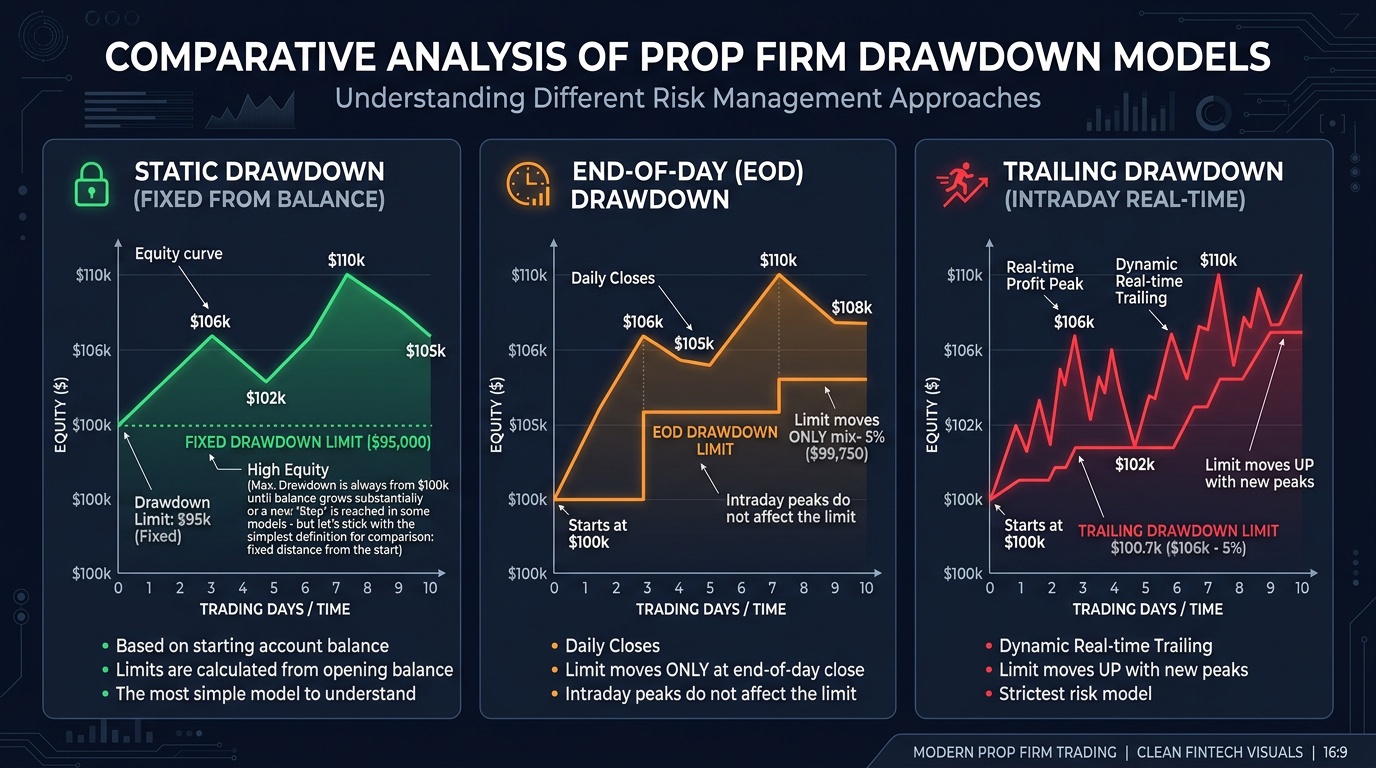
Drawdown rules are the single most consequential mechanic in prop trading. Misunderstanding them is the leading cause of account terminations. In 2026, three drawdown structures dominate the market.
Daily Drawdown
The daily drawdown caps how much you can lose from a defined starting equity within a single trading day. Most firms reset this at 5:00 PM ET. A typical limit is 4–5% of starting balance.
Example. On a $100,000 account with a 5% daily drawdown, if your equity at the start of the trading day is $102,000, your floor for that day is $96,900 (5% below $102,000 — calculated against starting balance, not equity, depending on the firm). Touching that level intraday — even for a millisecond on an unrealized basis at many firms — terminates the account.
The key trap: many firms calculate daily drawdown on equity, meaning unrealized losses count. A trade that recovers to breakeven still kills the account if it briefly dips past the threshold.
Maximum (Static) Drawdown
The static maximum drawdown is a fixed dollar floor below your initial balance that never moves. On a $100,000 account with a 10% max drawdown, your floor is $90,000 — permanently. As you grow the account, your buffer grows with it. This is the most trader-friendly model and is increasingly offered by reputable evaluation firms as a premium tier.
Trailing Drawdown
The trailing drawdown moves up with your account's high-water mark until it locks at the initial balance (in most modern variants). On a $100,000 account with a $4,000 trailing drawdown:
-
At equity $100,000 → floor $96,000
-
At equity $103,000 → floor $99,000
-
At equity $104,000 → floor $100,000 (locks here at most futures firms)
The danger: if you spike profits intraday and give them back, the trailing floor often advances based on the intraday high, not the closing balance. Traders who scalp aggressively and run unrealized profits into closing flat are most exposed.
For a side-by-side comparison of how the major firms structure these rules in 2026, see New Drawdown Rules Across Prop Firms: 2026 Industry Comparison.
Leverage and Instrument Restrictions You Must Check
Leverage and tradable instruments vary dramatically by asset class and firm. Always read these specs before purchase, not after.
Forex. Standard leverage is 1:30 to 1:100 on majors at most CFD-based prop firms in 2026, down from 1:200 a few years ago. Exotic pairs are typically capped at 1:20 or banned outright during major news windows.
Futures. Leverage is implicit through margin requirements set by the exchange and the firm's intraday multiplier. Most futures prop firms allow trading at exchange day-margin (often 1/10 of overnight margin) but restrict overnight holding entirely on evaluation accounts.
Indices and commodities. Typically 1:20 to 1:50 leverage on CFD firms. Gold often gets reduced leverage during volatile sessions, and many firms now restrict trading 2–5 minutes around major US economic releases (CPI, NFP, FOMC).
Crypto. Leverage rarely exceeds 1:5 on prop firms in 2026, and weekend trading is widely restricted due to liquidity gaps.
Common instrument bans:
-
Trading during the first or last 60 seconds of a session
-
Holding positions over weekends on evaluation accounts
-
Hedging across correlated pairs to game drawdown calculations
-
News trading windows (typically 2 minutes before to 2 minutes after high-impact events)
A firm that buries instrument restrictions in a downloadable PDF rather than displaying them prominently is signaling that traders frequently get caught by them. That should weigh on your purchase decision.
Payout Splits, Frequency, and Withdrawal Reliability
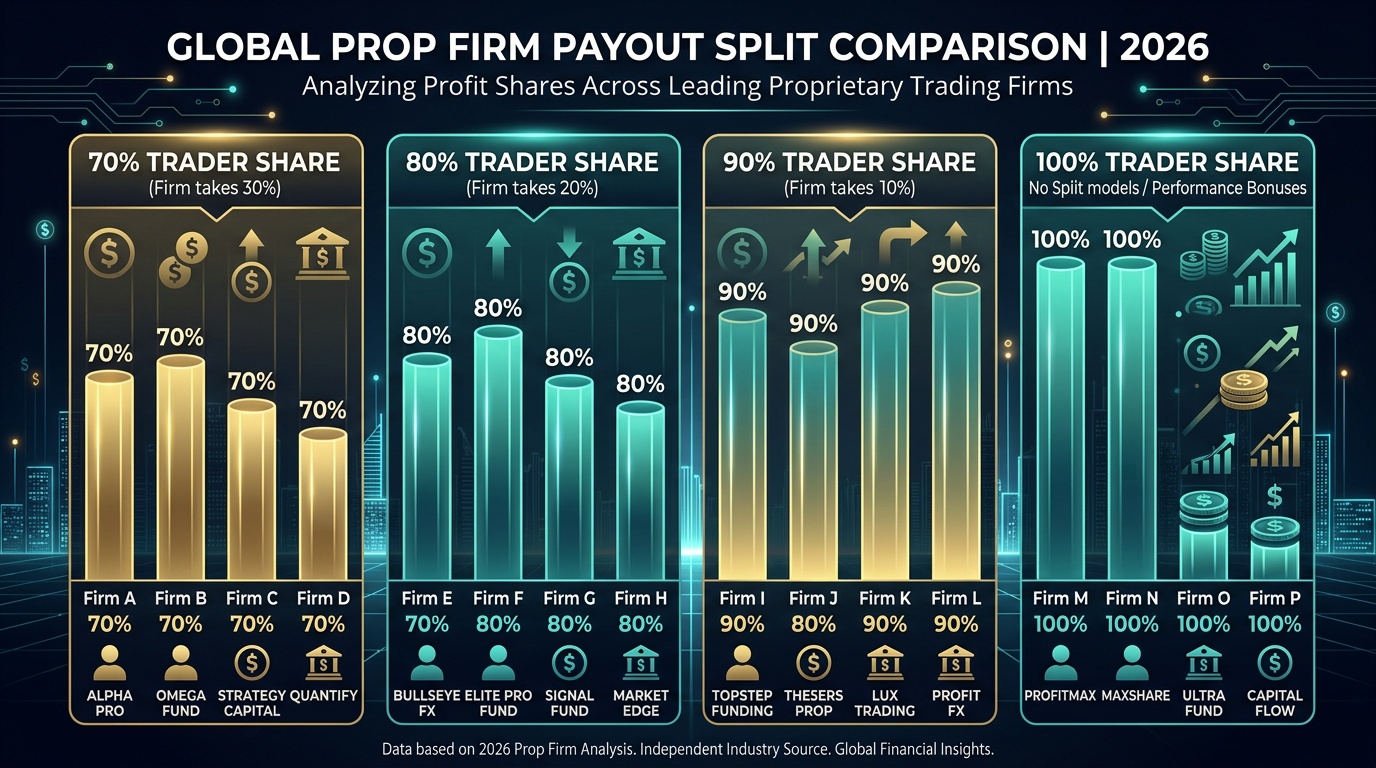
Profit splits get most of the marketing attention, but split percentage matters less than three other factors: payout reliability, payout frequency, and the conditions attached to your first withdrawal.
Split Tiers in 2026
The current market standard breaks down roughly as follows:
-
80/20 — The legacy industry standard, still common at conservative firms with strong balance sheets.
-
85/15 — The most common split for funded accounts in 2026.
-
90/10 — Offered by competitive mid-market firms, often as an upgrade or scaling reward.
-
100/0 (first payout) — A marketing tactic where your first withdrawal returns 100% of profit, then reverts to standard split.
A 90/10 split from a firm that pays 60% of withdrawal requests is worth less than an 80/20 split from a firm that pays 99%. Ratio means nothing without reliability.
Payout Frequency
Standard payout cycles in 2026 are:
-
Bi-weekly (14 days) — The current industry default.
-
Weekly — Increasingly offered as a competitive differentiator, often after the first three payouts.
-
On-demand — Available at instant-funding firms and a small number of premium evaluation firms; usually requires a minimum balance threshold.
What "Reliable Payouts" Actually Means
A reliable payout firm in 2026 demonstrates the following:
-
Public dashboard showing total cumulative payouts with timestamps
-
Consistent processing times within stated SLA (typically 24–72 hours)
-
Multiple withdrawal rails (bank wire, crypto, Wise, Deel)
-
Clear KYC requirements stated upfront — not introduced after your first payout request
-
A documented dispute resolution process
When a firm refuses to publish payout data, treat their advertised split as marketing fiction.
Hidden Gotchas: Consistency Rules, IP Bans, and EA Restrictions
This is the section that costs traders the most money. Beyond the headline rules every firm advertises, there is a layer of fine-print clauses designed to disqualify a meaningful percentage of profitable accounts. Reading the full terms of service is non-negotiable.
Consistency Rules
A consistency rule typically states that no single trading day's profit may exceed a certain percentage (commonly 30–50%) of your total profits at the time of withdrawal. The intent is to prevent traders from getting lucky on one trade and cashing out. The practical effect is that traders who hit a strong day must continue trading to "balance out" their P&L distribution before being eligible to withdraw.
If a firm has a consistency rule, model how your typical trading style would interact with it before funding. Traders running concentrated, high-conviction systems are most exposed.
IP, Region, and Account-Sharing Bans
Most firms now prohibit:
-
Trading from multiple IP addresses or VPNs without disclosure
-
Sharing account credentials with anyone (including signal services or copy traders not run by the firm)
-
Holding multiple accounts in different names tied to the same person
-
Operating from sanctioned jurisdictions
Violations typically result in account termination and forfeiture of any pending payout. Many traders have lost five-figure withdrawals to copy-trading violations they did not realize were prohibited.
EA, Algo, and Latency Restrictions
Expert Advisors and algorithmic strategies are widely allowed in 2026 but with caveats:
-
HFT-style strategies (sub-second holds) are banned at most CFD firms
-
Latency arbitrage between brokers is universally prohibited
-
News-trading EAs are typically banned outright
-
Tick-scalping that exploits broker pricing is grounds for termination
-
Copying signals between accounts (even your own) often counts as "account mirroring" and is restricted
If you intend to deploy any automation, request explicit written confirmation from the firm before purchasing — and save that response.
For traders preparing to navigate evaluation rules in detail, our How to Pass a Prop Firm Challenge: The Complete Guide walks through risk management approaches that survive these constraints.
Pros & Cons Summary Table of Top Prop Firm Models
The 2026 market has consolidated around three primary funding models. Each has distinct trade-offs.
| Model | How It Works | Pros | Cons | Best For |
|---|---|---|---|---|
| Evaluation (1- or 2-Step) | Pay a fee, pass profit target without violating rules, get funded | Lowest upfront cost, large account sizes, trader-friendly splits at top firms | Slow path to funding, multiple resets common, time pressure | Disciplined traders building track record |
| Instant Funding | Pay higher fee, trade live capital immediately with no challenge | No evaluation friction, faster to first payout, simpler rules | Smaller account sizes, tighter drawdowns, lower splits initially | Experienced traders with proven edge |
| Hybrid (Express/Skip-Eval) | Pay mid-tier fee, complete one short verification phase, then funded | Balance of cost and speed, moderate drawdowns | Limited firm availability, often newer products with less track record | Intermediate traders avoiding long evaluations |
For a deeper analysis of the no-challenge segment, see Instant Funding Models Gain Traction: The No-Challenge Prop Firm Movement in 2026.
Our #1 Recommended Prop Firm vs. the Rest
After applying the trust framework, drawdown analysis, payout reliability checks, and gotcha audits described above to the major firms in 2026, the AskPropFirm editorial team's #1 recommended firm consistently outperforms alternatives across the metrics that actually matter to traders: payout consistency above 98% on verified withdrawals, transparent static-drawdown options on funded accounts, weekly payout cadence after the first cycle, no consistency-rule traps, and a published rule book that has remained stable for over 18 months.
By contrast, the mid-tier firms that aggressively market 90/10 splits and oversized account sizes typically fall short on at least one of the following: payout SLA reliability, retroactive rule changes, opaque ownership, or restrictive consistency clauses that limit real withdrawal capacity.
When evaluating where to deploy your evaluation fees in 2026, weight your decision in this order:
-
Payout reliability (verified history, not marketing)
-
Drawdown structure (static and intraday, not just trailing)
-
Rule stability (rule book unchanged for 12+ months)
-
Ownership transparency (legal entity, jurisdiction, founders publicly known)
-
Consistency clause realism (no hidden caps that erase profitable months)
Only after these five filters should fee size, profit split percentage, or account size influence your choice. Marketing pages optimize for what looks good on a comparison table; the framework above optimizes for what actually shows up in your bank account six months from now.
Conclusion
The 2026 prop firm landscape rewards traders who slow down at the contract stage and verify the metrics that move money — payout SLAs, drawdown mechanics, written rule history, and ownership transparency — long before they ever click "Buy Challenge." Use the framework in this guide as a pre-purchase checklist: if a firm cannot answer four of the five filters above with documentation, walk away. There is no shortage of evaluation accounts on offer, but there is a real shortage of firms whose rule book and payout history will still be intact when your funded account scales to a size worth defending. Bookmark this guide, revisit it before every new evaluation purchase, and let the data — not the discount code — make the call.