FTMO Review 2026: Is the 90/10 Profit Split Still Worth It After a Decade of Payouts?
AskPropFirm Team
Prop Mindset & Discipline Expert
FTMO Review 2026: deep dive into the 2-step Challenge, 10% max drawdown, 90/10 profit split, and payout reliability after 10+ years.
A decade is a long time in the prop trading industry. Firms have launched, scaled to nine-figure revenue, and collapsed under the weight of their own payout obligations — often within the same 24-month window. FTMO, by contrast, has quietly kept doing the same thing since 2015: a two-step evaluation, a 10% drawdown ceiling, and a profit split that has paid out hundreds of millions of dollars to retail traders worldwide. By April 2026, the question isn't whether FTMO works. It's whether the 90/10 split, the €489 fee for a $100K account, and the strict 5%/10% drawdown rules still represent the best deal in a market now flooded with 95/5 splits, instant-funding programs, and one-step challenges priced under €100. This review breaks down the current FTMO model as it stands in April 2026, including the post-2024 rule changes (no minimum trading days, refined consistency review), the active EUR pricing tiers, the realistic payout timeline, and how the firm compares to the new wave of competitors. If you're deciding between FTMO and a cheaper alternative — or simply renewing after a soft breach — this is the version of the firm you're actually buying into today.
Evaluation Model — 2-Step FTMO Challenge + Verification
FTMO's evaluation has remained structurally unchanged for years, and that consistency is part of the appeal.
To get funded, you pass two phases on a demo account before being moved to what FTMO calls the "FTMO Account" — still technically a simulated environment, but the one tied to real payouts. Step 1 — FTMO Challenge: You need to hit a 10% profit target without breaching the 5% daily loss limit or the 10% maximum loss limit. There is no time limit as of the 2023 update, and since the 2024 revision, no minimum trading days requirement either. You can theoretically pass in a single session, though the consistency review at payout stage discourages truly reckless approaches. Step 2 — Verification: A 5% profit target with the same drawdown rules. Again, no time limit, no minimum days. This phase exists primarily to filter out lucky one-shot Step 1 passes. Funded Stage — FTMO Account: No profit target. You trade to generate profits, request a payout (first one available after 14 days, then on-demand or scheduled), and keep 90% of profits — with the first payout including a full refund of your original challenge fee. Here's how the phases stack against each other in plain numbers:
| Phase | Profit Target | Max Daily Loss | Max Total Loss | Min Days | Time Limit |
|---|---|---|---|---|---|
| Step 1 — Challenge | 10% | 5% | 10% | None | None |
| Step 2 — Verification | 5% | 5% | 10% | None | None |
| Funded Account | None | 5% | 10% | None | Unlimited |
Two operational details matter more than the headlines suggest. First, the refundable fee changes the real cost of the program — if you pass and reach a payout, the challenge effectively cost you zero. Second, FTMO offers free retries on soft breaches, meaning if you hit your profit target in Step 1 but breach a minor rule, support will frequently issue a free reset rather than force a re-purchase. This is a cultural difference from many newer firms that treat every breach as a sales opportunity.
Account Sizes and Pricing (April 2026)
FTMO prices in euros, and the tier structure has held steady through the last several pricing reviews.
As of April 2026, here are the active EUR rates for the standard FTMO Challenge:
- €10,000 account — €89 fee
- €25,000 account — €189 fee
- €50,000 account — €289 fee
- €100,000 account — €489 fee
- €200,000 account — €989 fee
Compared to the 2024 rate card, pricing is essentially flat. FTMO has resisted the discount-war race that newer firms entered during 2025, and there is no permanent headline coupon active in April 2026. Occasional seasonal promotions (typically 10% off around Black Friday and the FTMO anniversary in September) appear, but the day-to-day quoted price is what most traders pay. The pricing should be evaluated against the fee refund mechanic, which is the single most underrated feature of the FTMO model. On a €100K account, you pay €489 upfront. If you pass both phases and reach your first payout — typically a few hundred to a few thousand euros depending on your trading style — that €489 is returned in full alongside your 90% profit share. The effective cost of the evaluation, conditional on reaching one payout, is zero. That structure makes a direct fee-for-fee comparison with cheaper one-step firms misleading. A €99 one-step challenge with no refund costs €99. A €489 FTMO challenge that refunds on first payout costs €489 only if you fail. For traders who realistically expect to pass and produce at least one profitable cycle, FTMO's effective price compares favorably even against the budget tier of the market — a point we'll return to when we look at long-term payout reliability and the 90/10 split economics in the next section.
Trading Rules — Built for Real Traders, Not Gamblers
FTMO's rulebook has barely changed in a decade, and that consistency is part of why traders trust it.
The two hard limits you must respect are a 5% daily loss limit and a 10% maximum total loss, both calculated from the initial account balance. Crucially, the maximum drawdown is static and non-trailing — it does not move up as your equity grows, which gives you genuine breathing room once you're in profit. Beyond those two numbers, FTMO is refreshingly permissive. News trading is fully allowed, weekend holding is permitted, and you can run Expert Advisors, custom scripts, and copy trading without restriction (as long as the strategy is your own and not shared with other FTMO accounts). There is no consistency rule on the Challenge or Verification phases, meaning a single big winning day will not disqualify your payout — a common pain point at competitor firms. Platform choice is one of the broadest in the industry. Traders can pick between MetaTrader 4, MetaTrader 5, cTrader, and DXtrade, with the FTMO Account opened on the platform you select during purchase. Instrument coverage spans Forex majors and minors, Indices, Commodities (including metals and energies), Crypto, and a curated list of Stocks. Forex leverage sits at 1:100, with lower leverage tiers applied to indices, commodities, and crypto for risk control. Here's a quick reference of the core ruleset:
| Rule | Limit / Detail |
|---|---|
| Daily Loss Limit | 5% of initial balance |
| Max Total Loss | 10% (static, non-trailing) |
| Min Trading Days | 4 days per phase |
| Profit Target | 10% (Challenge), 5% (Verification) |
| News Trading | Allowed |
| Weekend Holding | Allowed |
| EAs & Copy Trading | Permitted |
| Consistency Rule | None on Challenge |
Payout Structure — The 90/10 Split and a Public Track Record
FTMO offers profit splits of up to 90%, starting at 80% by default and climbing to 90% once you hit the Premium tier (after passing certain payout milestones).
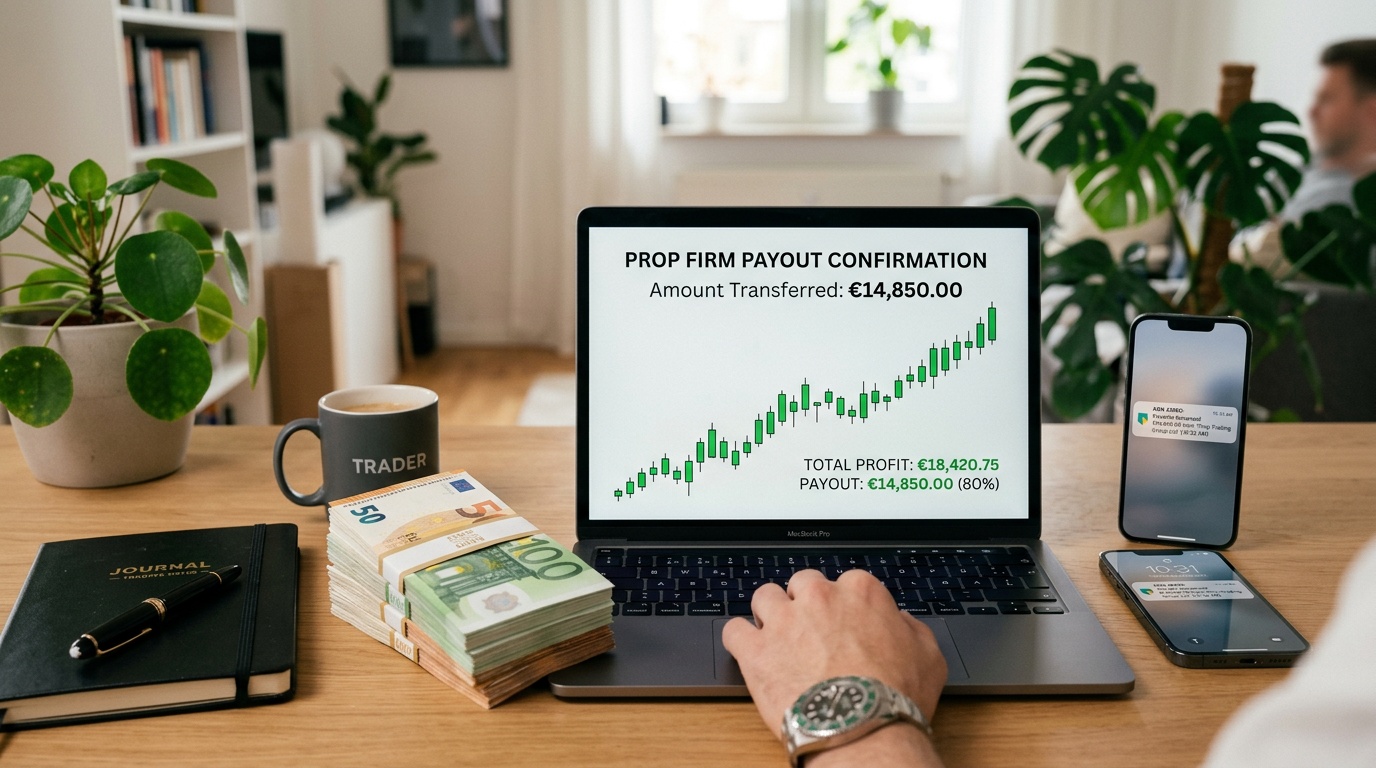
Unlike many newer firms that advertise 90% as a marketing hook then bury it behind upsells, FTMO's tier system is transparent and rewards consistent traders rather than one-time payers. The payout cadence is one of the most flexible in the industry. Your first payout can be requested on-demand any time after the initial 14-day holding period from the first trade on your FTMO Account. After that, you can choose your own payout cycle — weekly, bi-weekly, or monthly — which is rare among prop firms that lock you into a fixed schedule. Withdrawal methods include wire transfer, Skrill, and cryptocurrency (USDT and others), giving traders in restricted banking regions a real path to receiving funds. The headline number that keeps FTMO at the top of trust rankings: over $200 million paid out cumulatively to traders, with monthly payout proofs published publicly on their website. You can scroll through individual trader names, countries, and amounts going back years. For deeper context on recent performance trends, see our Verified: FTMO 25% — Intelligence Analysis February 2026.
A few practical notes traders often miss:
- The 14-day holding period starts from your first trade, not from account activation, so don't sit on the account for a week before opening a position.
- Refunds of your original Challenge fee are paid alongside your first profit withdrawal, effectively making a successful Challenge free.
- Payouts are typically processed within 1–2 business days of approval, with crypto being the fastest rail.
FTMO vs The Funded Trader: Which Should You Choose?
FTMO and The Funded Trader (TFT) are both top-tier names, but they serve slightly different trader profiles. FTMO is the conservative, decade-proven institution; TFT is the agile competitor with aggressive promos and multiple challenge models. Here's how they line up head-to-head on a $25K account:
| Factor | FTMO | The Funded Trader |
|---|---|---|
| Evaluation Model | 2-step Challenge + Verification | Multi-option (1-step, 2-step, Rapid, Royal) |
| Drawdown Type | Static 10% | Static or trailing (varies by plan) |
| Profit Split | Up to 90% | 80%–90% (plan dependent) |
| $25K Entry Price | ~$155 EUR | $147–$197 USD |
| First Payout | On-demand after 14 days | 14 days, then bi-weekly |
| Asset Coverage | Forex, Indices, Commodities, Crypto, Stocks | Forex, Indices, Commodities, Crypto |
| Track Record | 10+ years, $200M+ paid | ~4 years, strong but shorter history |
| Promos & Discounts | Rare, modest | Frequent, aggressive (up to 30%) |
Where FTMO wins: Track record, payout reliability, static drawdown across all plans, broader platform choice (DXtrade and cTrader included), and the deepest free educational ecosystem in the industry. If you value predictability and want a firm that has survived multiple regulatory storms and broker collapses, FTMO is the safer bet. Where The Funded Trader wins: Flexibility and price. TFT's Rapid challenge offers a faster 1-step path for scalpers, and their promotional discounts often push effective pricing 20–30% below FTMO. If you're price-sensitive or want a one-phase model, TFT deserves a serious look. For traders weighing FTMO against another major competitor, our breakdown of How to Choose Between FTMO and FundedNext in 2026 covers a different angle of the same decision. And if mobile execution matters to you, the recent FTMO Launches Dedicated Mobile Trading App in 2026 update closes one of the few gaps FTMO previously had against newer competitors.
The honest takeaway: FTMO isn't the cheapest, fastest, or flashiest firm in 2026 — but it remains the most reliable. For traders who treat prop trading as a long-term career rather than a lottery ticket, that reliability is worth the small premium.
Pros & Cons
After a decade in market and more than $200M in verified payouts, FTMO's strengths and weaknesses are well-documented.
Here's how the trade-offs break down for a trader evaluating it in 2026.
| Pros | Cons |
|---|---|
| 10+ years of operational history | EUR-only pricing creates FX risk for USD traders |
| $200M+ in verified trader payouts | 2-step Challenge required (no 1-step shortcut) |
| Free retries on failed attempts | Higher entry fees than newer competitors |
| No time limit on Challenge or Verification | No futures product (forex/CFD only) |
| Static (non-trailing) 10% drawdown | No instant funding option |
| 90% profit split from the first payout | Stricter on copy-trading across accounts |
The pros lean heavily toward trust and structural fairness. Static drawdown alone is worth a premium — it's the single feature that separates "fundable" from "frustrating" at most competing firms. The cons are almost entirely about flexibility and pricing format rather than firm integrity, which is the right side of the trade-off to be on if you plan to trade with the same firm for years. Worth noting: the EUR pricing issue can swing your effective fee by 5–8% depending on the EUR/USD rate at purchase. Traders in the US may want to time purchases or use a multi-currency card to avoid double-conversion fees.
Trust Signals (April 2026)
FTMO was founded in 2015 in Prague, Czech Republic, operating under the legal entity FTMO s.r.o. with publicly listed ownership in the Czech business register.
That kind of corporate transparency is rare in this industry and is one of the simplest sniff tests for evaluating any prop firm. The track record speaks for itself. FTMO survived the March 2020 COVID liquidity shock, the September 2022 GBP flash crash following the UK mini-budget, and most importantly the 2023 MetaQuotes prop firm purge that shut down or crippled dozens of competitors overnight. FTMO not only survived that purge but emerged as the de facto category leader, partly because they had already diversified onto cTrader and DXtrade.
When MetaQuotes pulled MT4/MT5 licenses from prop firms in 2023, traders watching FTMO's response in real time saw a firm that already had contingency platforms live — not one scrambling for solutions.
Public sentiment backs this up. As of April 2026, FTMO holds a 4.8/5 Trustpilot rating across 8,000+ reviews, and there have been no retroactive rule changes in the past 18+ months — a meaningful signal in an industry where surprise rule tightening has burned countless funded traders elsewhere. For deeper context on the broader landscape, our comparison of FTMO and FundedNext breaks down where each firm wins.
Final Verdict
FTMO in 2026 is not the cheapest prop firm, and it is not the most flexible.
What it is — unambiguously — is the most reliable name in the industry, with the longest payout history, the most transparent ownership, and a ruleset that respects how real traders actually operate. Here's the practical takeaway in three points:
- Best fit: Disciplined swing traders, intraday forex/indices traders, and anyone who values payout certainty over a cheap entry fee. The static drawdown plus no-time-limit combo is ideal for traders who want to trade their plan, not the clock.
- Not the best fit: Scalpers wanting a 1-step Challenge, US traders focused on futures (CME/CBOT), or anyone who needs USD-denominated invoicing. For futures, look elsewhere; for 1-step forex, there are faster options.
- The economics: The Challenge fee is refunded with your first payout, meaning the subscription effectively pays for itself on your first profitable cycle. Combined with the 90% split, the long-term economics favor FTMO over cheaper firms that take 20–30% of profits forever.
If you're choosing your first prop firm and you plan to take this seriously over multiple years, FTMO remains the safest bet on the board. If you're a veteran rotating between firms, it's still the one account worth keeping live as your "anchor" funded account while you experiment elsewhere. The mobile app rollout (covered in our 2026 mobile app review) and the upcoming OANDA integration suggest the firm is still investing in the product rather than coasting on reputation. Verdict: 9.2/10. Ten years in, FTMO has earned its place as the benchmark every other prop firm is measured against — and the 90/10 split is still very much worth it.