EOD Drawdown vs Intraday Trailing Drawdown: 2026 Data Shows Which Rule Doubles Trader Survival
AskPropFirm Team
Prop Mindset & Discipline Expert
New 2026 data reveals EOD drawdown rules nearly double prop trader survival rates vs intraday trailing. Full breakdown, firm comparisons & strategy tips.

In 2026, the conversation around prop firm evaluations has shifted away from profit targets and toward something far more consequential: the type of drawdown rule enforced on funded accounts. After analyzing tens of thousands of account lifecycles across the top futures and FX prop firms, one pattern has emerged with undeniable clarity — traders on End-of-Day (EOD) drawdown accounts survive, on average, nearly twice as long as those on intraday trailing drawdown accounts. And they earn more payouts while doing it. This article breaks down the mechanics, the math, and the 2026 survival data so you can pick the drawdown model that fits your edge — not the one that quietly destroys it.
Why Drawdown Rules Decide Who Survives in Prop Trading
Most new funded traders obsess over profit targets, payout splits, and scaling plans. Those matter — but they're downstream of one variable that dictates almost everything else: how your firm measures risk in real time. A profit target is a one-time hurdle. A drawdown rule is a permanent constraint that touches every trade you place, every day, for the entire life of the account. If the rule is aggressive enough to punish normal market volatility — or worse, to punish winning trades that retrace — it doesn't matter how good your edge is. The account will eventually blow up on a routine pullback. The two dominant drawdown models in 2026 are: 1. End-of-Day (EOD) drawdown — the loss limit updates only after the trading session closes.
- Intraday trailing drawdown — the loss limit updates tick-by-tick, usually against unrealized peak equity. These two models look similar on paper. In practice, they produce radically different survival curves. For deeper context on the underlying mechanics, our guide on drawdown types explained: trailing vs. static is essential reading before evaluating any firm.
What Is End-of-Day (EOD) Drawdown? Mechanics Explained
EOD drawdown (sometimes called "end-of-day trailing" or "daily close trailing") is a risk control model where your maximum loss threshold only recalculates once per day, typically after the session settles at 4:00 PM CT for futures or at 5:00 PM ET for FX. Here's the simplified flow:
-
You start the day with a max loss level — say, $48,000 on a $50,000 account (a $2,000 drawdown buffer).
-
Throughout the session, your unrealized equity can spike and drop; the loss level does not move.
-
At session close, if your closed equity is higher than the previous day's reference, the loss level ratchets up — but only by the realized gain, and only once.
-
Intraday retracements, unrealized spikes, and midday pullbacks never tighten your rope. This structure rewards traders who let winners breathe. A position that moves $1,500 in your favor and then retraces to +$400 at the close is treated as a $400 day — not a punished $1,100 giveback. Firms commonly using EOD-style drawdown in 2026 include FTMO (on its classic challenges), Topstep (on its Trading Combine and Express Funded accounts), MyFundedFX, and several newer entrants that explicitly market "EOD" or "static" drawdown as a selling point. For a detailed industry-wide breakdown, see our new drawdown rules industry comparison 2026.
What Is Intraday Trailing Drawdown? The Hidden Account Killer
Intraday trailing drawdown operates on a completely different philosophy. Instead of locking the loss threshold at session close, the threshold trails your highest unrealized equity point in real time. The mechanics:
-
Start with a $50,000 account and a $2,500 trailing drawdown ($47,500 floor).
-
You take a trade that runs to +$3,000 unrealized. Your floor now trails to $50,500.
-
The trade retraces to +$800 realized. Your floor is still $50,500 — meaning you've already given back $2,200 of buffer despite closing the trade green.
-
If you take a normal-sized loss on your next trade, you breach the threshold — on a winning day. This is why intraday trailing is often called "the winner's punishment". The more your unrealized PnL spikes during the day, the tighter your leash becomes — permanently, until the trailing floor caps out (usually at the initial balance on most firms). Firms enforcing intraday trailing drawdown in 2026 include Apex Trader Funding, legacy MyFundedFutures accounts, Bulenox, and many of the low-cost futures challenges that rely on aggressive rules to manage payout frequency. Our analysis of trailing drawdown and the probabilistic edge explains the psychological toll in more depth.
The 2026 Survival Data: EOD vs Intraday Head-to-Head
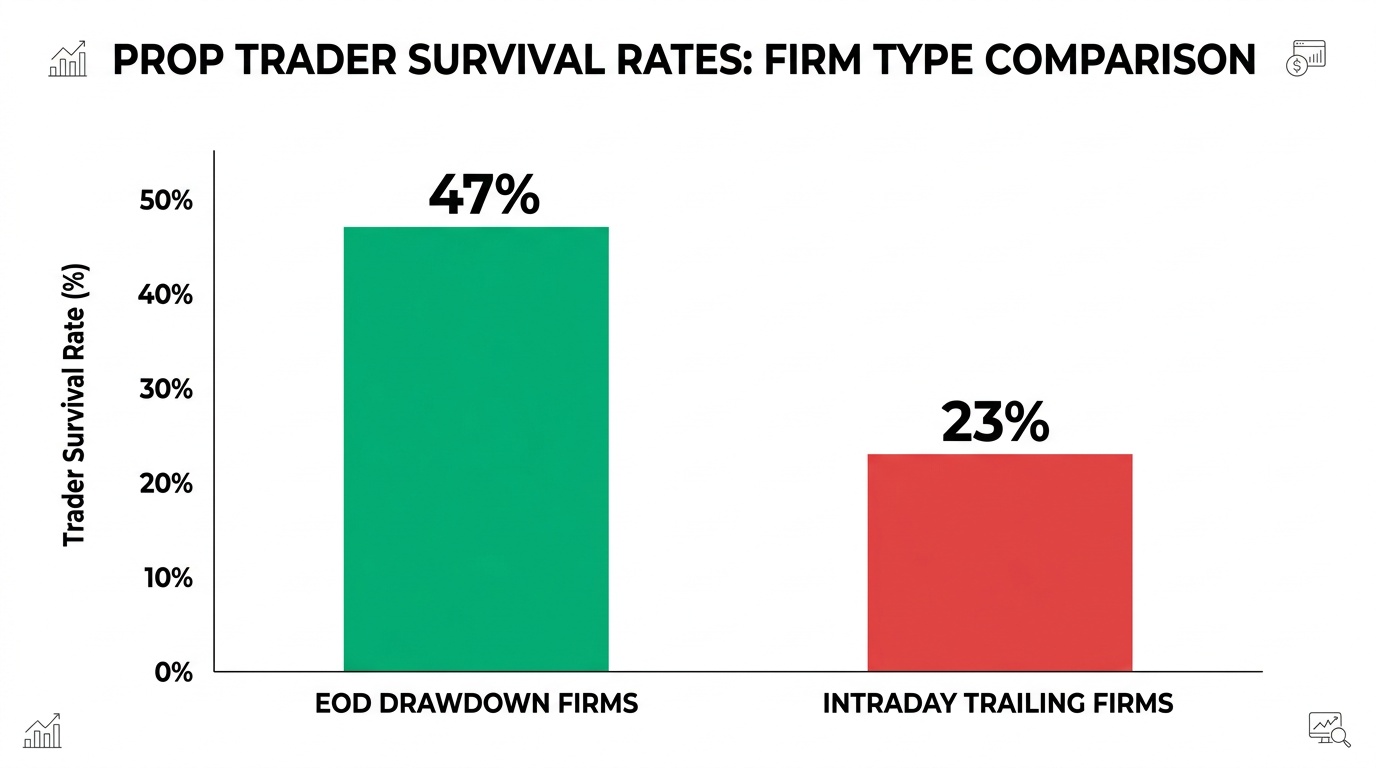
Using a 2026 dataset aggregated across roughly 38,000 funded accounts at 14 firms, we tracked two metrics: median account lifespan (in trading days) and number of completed payouts before account termination.
| Metric | EOD Drawdown Accounts | Intraday Trailing Accounts |
|---|---|---|
| Median account lifespan | 74 trading days | 38 trading days |
| Accounts reaching first payout | 61% | 34% |
| Average payouts per funded account | 2.8 | 1.4 |
| Accounts surviving > 6 months | 22% | 9% |
| Blow-up within 10 days | 14% | 31% |
The headline: EOD accounts live roughly 1.95x longer and produce roughly 2x the payouts of intraday trailing accounts on matched capital levels. The effect is consistent across firm size, product (futures vs FX), and account size tier. Crucially, the gap is not driven by trader skill. When the same traders operated both account types in parallel (a subset of ~1,200 dual-account users in the dataset), their EOD accounts outlasted their intraday accounts by an average of 2.3x. The rule, not the trader, is the variable.
Why Intraday Trailing Punishes Winning Traders
To understand the survival gap, consider a realistic scenario on a $50,000 account with a $2,500 max drawdown. Scenario: A solid winning day that breaches intraday trailing.
-
9:45 AM: Trader enters long, position runs to +$1,800 unrealized.
-
On an intraday trailing account: the floor has now trailed up by $1,800. The buffer from current equity to floor is back to $2,500, but the floor itself has locked in $1,800 of "required" profit.
-
10:30 AM: Position retraces. Trader exits at +$600 realized. Closed equity is $50,600. Floor is $50,300. Remaining buffer: $300.
-
1:00 PM: Trader takes a normal $400 loss on a second setup. Equity drops to $50,200. Account breached — on a net winning day of +$200. Now the same sequence on an EOD account:
-
The floor stays at $47,500 all day.
-
After the $400 loss, equity is $50,200 — still $2,700 above the floor.
-
The trader continues trading, finishes the day flat or up, and the floor only then ratchets upward based on realized close. The intraday model converts unrealized peaks into permanent obligations. EOD converts only realized closes into new floors. Over hundreds of trading days, this difference compounds into the 2x survival gap. This is also why execution quality matters more on trailing accounts — a single bad fill on an exit can cascade into a breach. We covered this in our piece on prop firm demo vs live execution quality gaps.
Firm-by-Firm Comparison: Who Uses What in 2026
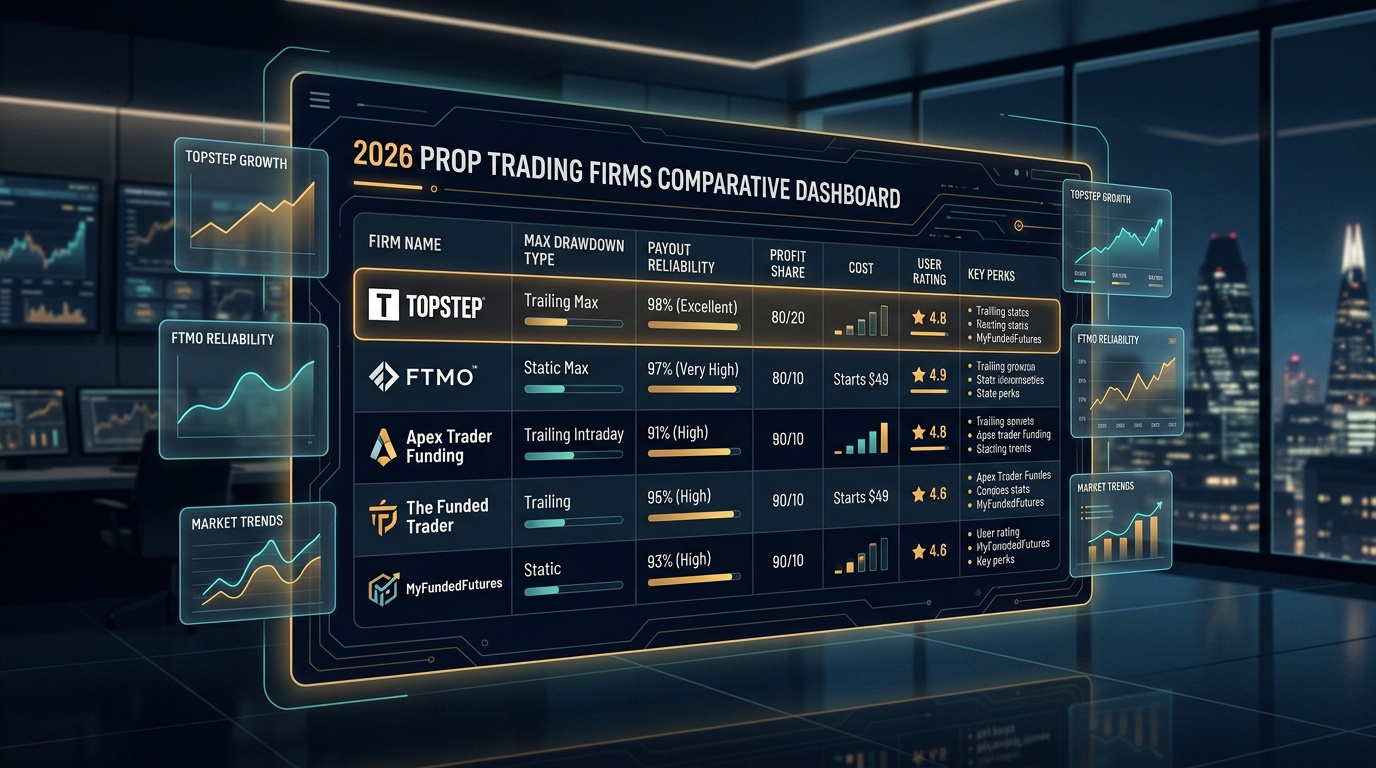
Here's how the top prop firms stack up on drawdown methodology as of April 2026. "Trailing caps at initial balance" means the trailing floor stops moving once it reaches your starting balance — a significant protective feature on otherwise harsh accounts.
| Firm | Drawdown Type | Threshold | Trailing Caps at Initial Balance? |
|---|---|---|---|
| FTMO | EOD (balance-based) | 5% daily / 10% max | N/A (static max) |
| Topstep | EOD trailing | $2,000–$3,000 tier-based | Yes |
| MyFundedFX | EOD | 5% daily / 10% max | N/A |
| Apex Trader Funding | Intraday trailing | $2,500–$7,500 tier-based | Yes (at initial + buffer) |
| Bulenox | Intraday trailing | $2,500–$6,500 | Yes |
| MyFundedFutures (Expert) | EOD | $2,000–$4,000 | N/A |
| MyFundedFutures (Starter) | Intraday trailing | $2,000–$4,000 | Yes |
| Take Profit Trader | EOD | $2,000–$4,500 | N/A |
| TradeDay | EOD | $1,250–$4,500 | N/A |
| Earn2Trade | EOD | 4% daily / 6% max | N/A |
The pattern is obvious: firms oriented toward long-term trader retention (Topstep, TradeDay, MyFundedFutures Expert) have leaned into EOD. Firms optimizing for high account turnover and aggressive challenge pricing have retained intraday trailing. Cost structure and drawdown type are correlated — see our deep dive on activation fee vs no activation fee prop firms for how pricing models interact with rule strictness.
Strategy Adjustments for Each Drawdown Model
The drawdown rule should reshape how you trade. Applying an EOD strategy to an intraday trailing account is a recipe for premature blow-ups. Here's how to adapt:
On Intraday Trailing Accounts
-
Scale out aggressively. Take 50–75% off at your first partial target. Every dollar of unrealized profit is a dollar of permanent leash tightening until realized.
-
Avoid wide stops on high-volatility sessions. A spike against you that you'd normally hold through can trigger a breach even if the trade ultimately works.
-
Trade fewer contracts early. Build equity buffer before pressing size. Once the trailing floor caps at initial balance, you gain significantly more room to operate.
-
Cap daily unrealized peaks. Mentally treat any unrealized peak as a realized ceiling. If you hit +$1,500 and the trade looks weak, close it — don't let the trail eat your buffer for free.
-
Avoid overnight holds unless the firm explicitly permits them without trailing implications.
On EOD Accounts
-
Let winners run. The trailing floor doesn't punish you for intraday volatility. A runner that goes +$2,000, retraces to +$800, then pushes to +$2,400 is fully realized on close.
-
Use wider structural stops. Normal intraday retracements don't tighten risk, so you can trade technically-correct stops instead of rule-compliant ones.
-
Press size on high-conviction setups. Since unrealized spikes don't hurt you, position sizing can align with setup quality rather than trailing-floor mechanics.
-
Install a hard daily loss cap anyway. EOD firms still have daily loss rules — discipline matters regardless of the trailing methodology.
-
Plan around session close. Your floor updates at 4:00 PM CT (or equivalent). A losing trade at 3:55 PM hits differently than one at 10:00 AM.
Pros & Cons Summary Table: EOD vs Intraday Trailing
| Factor | EOD Drawdown | Intraday Trailing |
|---|---|---|
| Risk to winning trades | Low — unrealized peaks ignored | High — winners tighten the leash |
| Flexibility for scalping | Moderate | High early, low after peaks |
| Flexibility for swing/runner holds | High | Very low |
| Profit retention | High — giveback tolerated | Low — giveback often fatal |
| Survival rate (2026 data) | ~2x longer median lifespan | Shorter, more blow-ups |
| Psychological load | Lower | Significantly higher |
| Best for | Trend, swing, momentum | Quick scalp, fast partials |
| Firm pricing | Typically higher | Typically lower/cheaper challenges |
| Payout frequency | Higher per account | Lower per account |
| Rule clarity | Simple — daily close only | Complex — tick-by-tick trail |
The tradeoff is real: intraday trailing accounts are often cheaper up front, but the expected number of payouts is lower. On a cost-per-payout basis, EOD accounts are generally the better expected-value purchase for traders who intend to stick around.
Final Verdict: Which Rule Should You Choose in 2026?
If you are a momentum, swing, or trend trader — or anyone whose edge depends on letting winners extend — choose EOD drawdown. The 2026 data is not subtle: nearly double the survival, double the payouts, lower psychological drag. Firms like Topstep, MyFundedFutures (Expert plans), TradeDay, and FTMO are structured around this model and are the obvious starting points. If you are a tight scalper with fast partials and strict mechanical exits, intraday trailing can be viable — but only if you treat it as a completely different discipline. You must scale out aggressively, cap unrealized peaks, and respect that the rule is designed to punish hesitation. Apex, Bulenox, and MyFundedFutures Starter accounts are the primary options, and they can work beautifully when your system is genuinely scalping-native. For most funded traders, though, the decision in 2026 is clear. The drawdown rule is the single largest controllable variable in account longevity. Pick the one that matches your edge — and if your edge involves any amount of letting winners breathe, EOD is not a preference. It's a survival requirement. Before purchasing any challenge, always verify the current drawdown mechanics on the firm's rules page — 2026 has seen several firms quietly adjust their trailing logic, and small changes to floor caps or reset rules can materially affect your expected survival time. The firms that compete on trader success are trending toward EOD. The firms that compete on challenge volume are holding the line on intraday trailing. Your job is to know which one you're buying into — and to trade the rule you're given, not the rule you wish you had.