No Activation Fee vs. Activation Fee Prop Firms: A Data-Driven Cost Comparison for 2026
Dr. Algo
Prop Mindset & Discipline Expert
We model the true total cost of activation-fee vs. no-activation-fee prop firms across three realistic trader scenarios so you can see which model actually saves money.
No Activation Fee vs. Activation Fee Prop Firms: A Data-Driven Cost Comparison for 2026
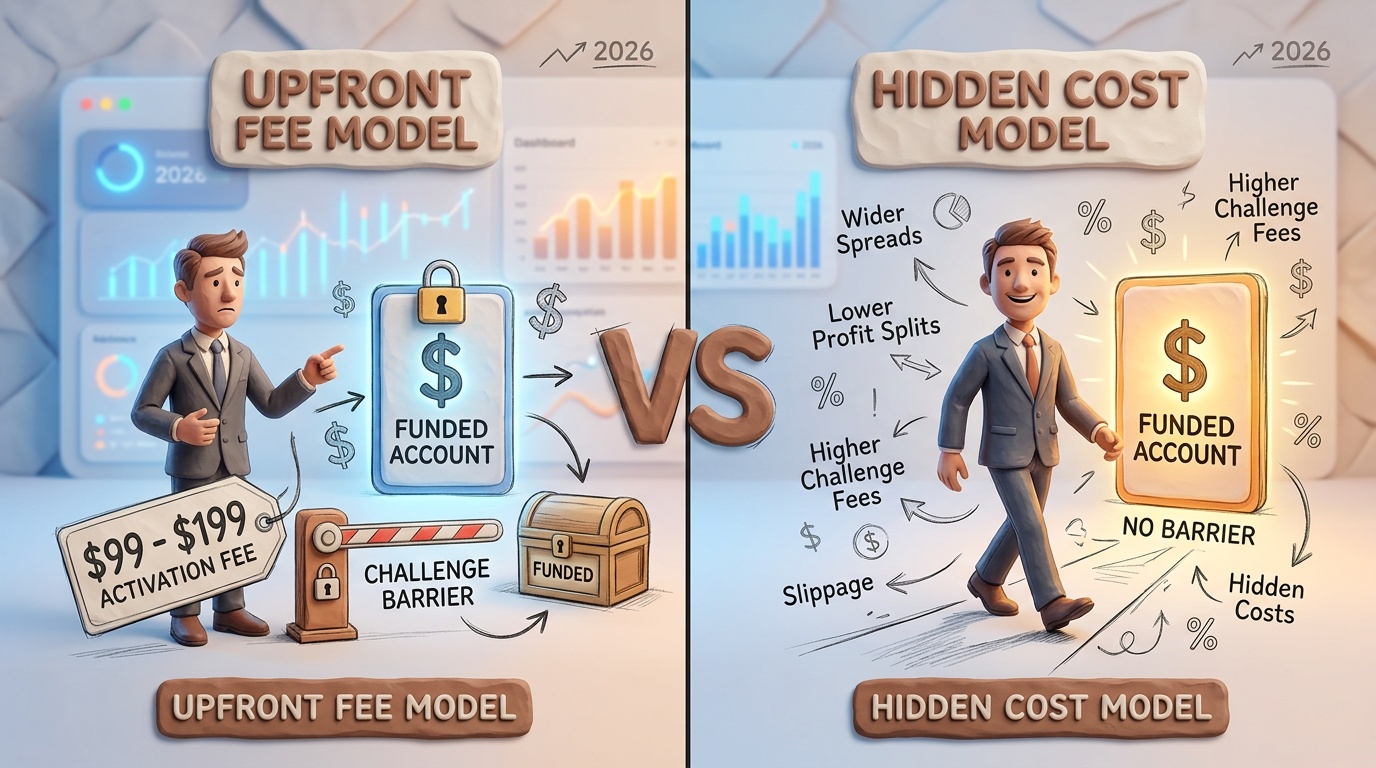
The $99–$199 Question Nobody's Modeling Correctly
You passed the challenge. You verified your identity. You signed the agreement. And then — right before you can place your first funded trade — you're hit with an activation fee ranging from $99 to $199 (sometimes more).
For some traders, it's a minor line item. For others, especially those who've already failed two or three challenges, it's the straw that breaks the cost-benefit analysis.
Yet the conversation around activation fees in prop trading remains surprisingly shallow. Most comparisons stop at "Firm X charges one, Firm Y doesn't." That tells you almost nothing about actual total cost, because the firms that skip the activation fee often recoup that revenue elsewhere — through wider spreads, lower profit splits, higher challenge fees, or more restrictive payout schedules.
In this guide, we're going to do what almost nobody does: model the true total cost of ownership across both fee structures using three realistic trader scenarios. We'll account for challenge pass rates, reset fees, data feeds, platform costs, and the compounding effect of multiple attempts. By the end, you'll have a clear framework for determining which model genuinely saves you money — not which one looks cheaper on a marketing page.
Activation Fees Explained: What They Are, Who Charges Them, and Why
Definition and Mechanics
An activation fee is a one-time charge levied after a trader successfully completes a prop firm's evaluation (challenge) and before they receive access to a funded account. It is separate from:
- The challenge fee (paid upfront to enter the evaluation)
- Monthly data fees (recurring charges for market data)
- Platform fees (software licensing costs)
- Reset fees (paid to restart a failed challenge)
The activation fee typically ranges from $49 to $299 depending on the account size, with $100K accounts commonly seeing fees in the $129–$199 range.
Why Do Firms Charge Them?
Prop firms that implement activation fees generally cite two reasons:
- Filtering commitment: The fee acts as a final filter to ensure traders who reach the funded stage are serious about trading (as opposed to those who passed by luck or aggressive gambling).
- Operational cost coverage: Setting up a funded account involves real infrastructure costs — provisioning server capacity, establishing risk parameters, setting up payout rails, and in some cases, routing orders to live liquidity.
From a business model perspective, activation fees also serve a third, less-discussed purpose: revenue diversification. Firms that rely entirely on challenge fees for revenue have an incentive structure that benefits from trader failure. Adding an activation fee creates a revenue event tied to trader success, which — at least theoretically — better aligns incentives.
Who Charges Them and Who Doesn't?
The landscape in 2026 breaks down roughly as follows:
| Fee Model | Typical Characteristics |
|---|---|
| Activation fee firms | Often lower challenge fees, higher profit splits (80–90%), may include first month of data |
| No activation fee firms | Often higher challenge fees, may have lower profit splits (75–85%), may charge separately for data/platform |
This is a generalization, and exceptions abound. But the pattern is consistent enough to model. The critical takeaway: neither model is inherently cheaper. The cost simply moves around.
Activation Fee vs. No Activation Fee: Model Comparison
To make this comparison fair, we need to establish baseline assumptions. We'll use a $100,000 futures account as our reference point, since futures prop firms are where activation fees are most common and most debated.
Baseline Cost Components
| Cost Component | Activation Fee Firm (Avg.) | No Activation Fee Firm (Avg.) |
|---|---|---|
| Challenge fee (one-time) | $350 | $450 |
| Activation fee | $149 | $0 |
| Monthly data feed | $0 (1st month included) then $45/mo | $45/mo from day 1 |
| Platform fee | $0 (included) | $0–$55/mo (varies) |
| Profit split | 90/10 | 80/20 |
| Payout frequency | Bi-weekly | Monthly |
| Reset fee | $175 | $225 |
Note: These figures represent aggregated averages across the major firms we track at askpropfirm.com. Individual firms will vary. If you're comparing specific options, our guides on Best Futures Prop Firms Compared in 2026 and Best Forex Prop Firms Compared in 2026 provide firm-by-firm breakdowns.
The Upfront Cost Illusion
At first glance, the no-activation-fee firm appears $149 cheaper. But the challenge fee is $100 higher, so the net difference for a trader who passes on the first attempt is only $49 in favor of the no-fee firm.
Now factor in the profit split difference. If a trader generates $5,000 in their first month:
- Activation fee firm (90/10): Trader keeps $4,500
- No activation fee firm (80/20): Trader keeps $4,000
The $500 profit split difference erases the $49 upfront savings in the very first profitable month. And it compounds every month thereafter.
This is why single-variable comparisons are misleading. You need to model the full journey.
Total Cost of Ownership: Three Trader Scenarios With Real Math
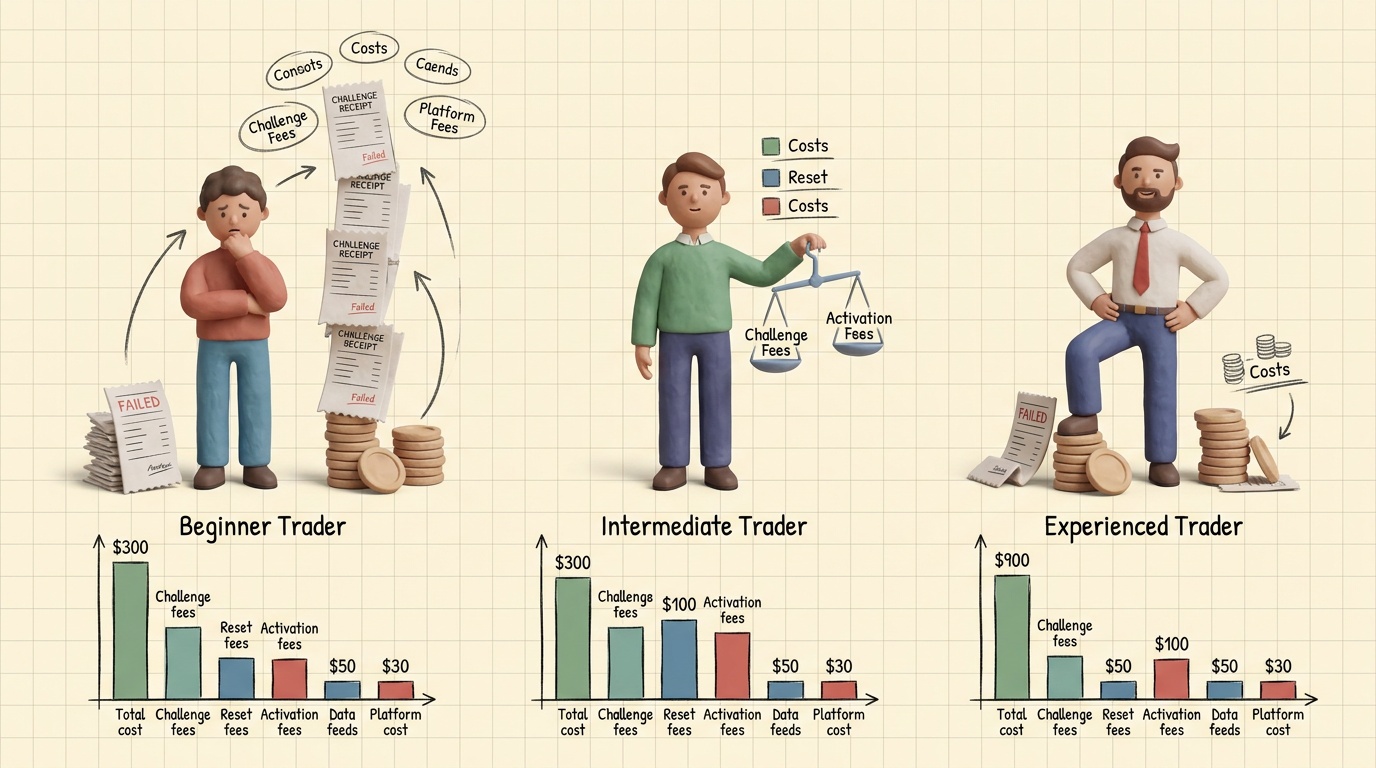
We've built three scenarios representing distinct trader profiles: a beginner who struggles with challenges, an intermediate trader who passes efficiently, and a consistent performer who holds a funded account for an extended period.
Scenario 1: The Struggling Beginner (3 Attempts to Pass)
Profile: New to prop trading, fails the first two challenges, passes on the third attempt. Generates modest profits of $2,000/month in the funded account. Holds the account for 4 months.
| Cost/Revenue Item | Activation Fee Firm | No Activation Fee Firm |
|---|---|---|
| Challenge fee × 1 | $350 | $450 |
| Reset fees × 2 | $350 | $450 |
| Activation fee | $149 | $0 |
| Data fees (4 months) | $135 (3 months × $45) | $180 (4 months × $45) |
| Total costs | $984 | $1,080 |
| Gross profit (4 months × $2,000) | $8,000 | $8,000 |
| Trader's share | $7,200 (90%) | $6,400 (80%) |
| Net profit after all costs | $6,216 | $5,320 |
Delta: $896 in favor of the activation fee firm.
The activation fee firm wins here for two reasons: lower reset fees compound across multiple attempts, and the superior profit split magnifies over months of trading. For beginners weighing their options, our Best Prop Firms for Beginners in 2026 guide addresses this dynamic in detail.
Scenario 2: The Efficient Intermediate (Passes First Try)
Profile: Experienced trader, passes the challenge on the first attempt. Generates $4,000/month in the funded account. Holds the account for 6 months.
| Cost/Revenue Item | Activation Fee Firm | No Activation Fee Firm |
|---|---|---|
| Challenge fee × 1 | $350 | $450 |
| Activation fee | $149 | $0 |
| Data fees (6 months) | $225 (5 months × $45) | $270 (6 months × $45) |
| Total costs | $724 | $720 |
| Gross profit (6 months × $4,000) | $24,000 | $24,000 |
| Trader's share | $21,600 (90%) | $19,200 (80%) |
| Net profit after all costs | $20,876 | $18,480 |
Delta: $2,396 in favor of the activation fee firm.
The upfront costs are essentially identical ($4 difference). But the 10-percentage-point profit split difference generates $2,400 more revenue over six months. This is the scenario where the activation fee is most clearly a bargain.
Scenario 3: The Consistent Performer (12-Month Funded Account)
Profile: Professional-grade trader, passes first try, generates $6,000/month. Holds and scales the account for 12 months.
| Cost/Revenue Item | Activation Fee Firm | No Activation Fee Firm |
|---|---|---|
| Challenge fee × 1 | $350 | $450 |
| Activation fee | $149 | $0 |
| Data fees (12 months) | $495 (11 months × $45) | $540 (12 months × $45) |
| Total costs | $994 | $990 |
| Gross profit (12 months × $6,000) | $72,000 | $72,000 |
| Trader's share | $64,800 (90%) | $57,600 (80%) |
| Net profit after all costs | $63,806 | $56,610 |
Delta: $7,196 in favor of the activation fee firm.
At scale, the profit split dominance becomes overwhelming. A $149 activation fee is generating an effective return of 48:1 ($7,196 ÷ $149) over a year of consistent trading.
The Pattern Is Clear
Across all three scenarios, the activation fee firm delivers higher net returns. But this isn't because activation fees are inherently good — it's because in our model, the activation fee firm offered a better profit split. If a no-activation-fee firm offers 90/10 splits while keeping challenge fees competitive, the calculus flips.
The lesson: never evaluate the activation fee in isolation. Evaluate the total fee package.
The Hidden Costs That Change the Equation
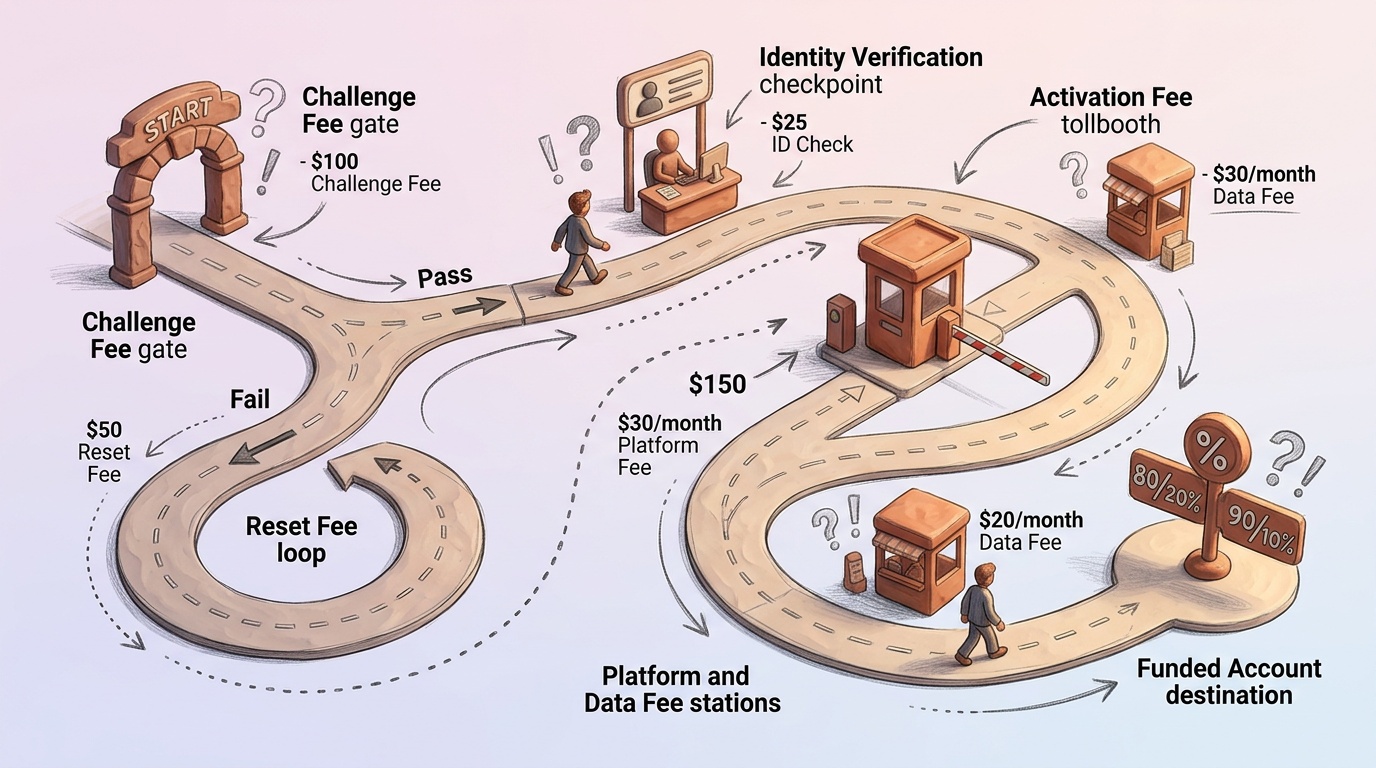
Our models above capture the major cost components, but several less-visible factors can shift the math significantly.
1. Execution Quality Gaps
Some firms — particularly those without activation fees and with suspiciously low challenge prices — route evaluation trades through demo servers with unrealistically favorable fills. When you move to the funded stage, slippage increases, and your effective edge shrinks.
A 0.5-tick average slippage increase on a trader doing 20 round-trip trades per day on ES futures translates to roughly $250/month in hidden costs. Over 6 months, that's $1,500 — dwarfing any activation fee savings.
2. Payout Processing Fees and Delays
Some no-activation-fee firms offset their revenue loss through:
- Higher payout minimums ($200–$500 vs. $50–$100)
- Longer payout processing times (7–14 business days vs. 1–3 days)
- Crypto-only payouts with conversion fees
- Percentage-based withdrawal fees (1–3%)
A 2% withdrawal fee on a $4,000 monthly payout is $80/month — $960/year. That's a recurring cost that an activation fee (which is one-time) can never match.
3. Account Inactivity and Maintenance Fees
Several firms charge inactivity fees if you don't trade for 7–30 consecutive days. Others charge monthly "platform maintenance" fees that are functionally equivalent to amortized activation fees — just distributed differently.
4. Scaling Program Access
Many activation-fee firms gate their scaling programs (which increase your account size and buying power) behind the activation fee. No-fee firms may charge separately for scaling reviews or require additional evaluation phases — each with its own fee.
5. Data Feed and Platform Infrastructure
The choice between trading platforms — and the data infrastructure behind them — has direct cost implications. Some firms bundle data costs into the activation fee; others charge separately regardless. For a deeper dive into how platform choice affects your bottom line, see Rithmic vs Tradovate: Which Futures Infrastructure Do Prop Firms Prefer in 2026?.
Forex vs. Futures: Why the Fee Model Differs by Market
The activation fee conversation plays out differently across markets, and conflating the two leads to poor decisions.
Futures Prop Firms
Activation fees are more common in futures because:
- Real market data costs money (CME data fees are non-trivial)
- Execution infrastructure is more expensive
- Account provisioning on platforms like Rithmic involves licensing costs
- Regulation and exchange fees create genuine overhead
In futures, activation fees of $100–$200 can be legitimately justified by infrastructure costs. The question is whether the fee is proportional to those costs or inflated for profit.
Forex Prop Firms
Activation fees are less common in forex because:
- Data is generally free (no exchange fees)
- MetaTrader/cTrader licensing is cheaper at scale
- Spread markup provides an alternative revenue stream
- Competition has pushed firms toward "no hidden fees" marketing
When a forex firm charges an activation fee, scrutinize it more carefully. The infrastructure justification is weaker, so the fee is more likely a pure margin item.
Crypto Prop Firms
The newest entrants, crypto prop firms, have largely adopted a no-activation-fee model. However, they tend to compensate through wider spreads, lower profit splits (70/30 or 75/25), and more restrictive drawdown rules.
Decision Framework: When Each Model Makes Sense
Rather than declaring one model universally better, use this decision framework based on your specific situation:
Choose an Activation Fee Firm When:
- The profit split is 85%+ and the no-fee alternative offers 80% or less. The split difference will recoup the activation fee within 1–2 profitable months.
- You have high confidence in passing the challenge. If you expect to pass on the first or second attempt, the activation fee is a small one-time cost.
- You plan to trade the funded account for 3+ months. The longer your time horizon, the more the profit split advantage compounds.
- The firm bundles data/platform fees into the activation cost. This can save $45–$100/month, quickly offsetting the upfront charge.
- The firm has verified, quality execution on the funded stage. An activation fee that grants access to genuine live execution is worth paying for.
Choose a No Activation Fee Firm When:
- You're testing multiple firms and don't want to commit capital beyond the challenge. If you're in "exploration mode," avoiding activation fees preserves capital.
- The profit split is equivalent (85%+) to activation-fee competitors. If you're getting the same split without the fee, the math is straightforward.
- You have a lower pass rate and expect multiple attempts. While reset fees are the bigger factor here, minimizing every cost per attempt matters when capital is limited.
- You trade forex or crypto where infrastructure costs don't justify the fee. The cost-justification argument is weaker outside of futures.
- The firm's payout structure is transparent and competitive. No activation fee means nothing if payouts take 14 days and come with a 3% processing charge.
Universal Due Diligence Checklist
Regardless of which model you choose, verify these before committing:
- Total first-year cost (challenge + resets + activation + data + platform + withdrawal fees)
- Effective profit split after all fees (not just the headline number)
- Payout reliability (check community reviews, not just firm claims)
- Execution quality consistency between evaluation and funded stages
- Drawdown rule fairness (some firms offset low fees with aggressive drawdown rules — see New Drawdown Rules Across Prop Firms: 2026 Industry Comparison for current standards)
- Contract terms (profit split changes, account termination clauses, fee increases)
Dr. Algo's Take
The prop trading industry has a marketing problem. Firms that charge activation fees get punished in comparison tables because the upfront number looks higher. Firms that skip the activation fee can advertise "NO HIDDEN FEES" while quietly recouping revenue through worse splits, slower payouts, and wider spreads.
Neither approach is inherently honest or dishonest. What matters is the total cost of ownership — and the data consistently shows that a $149 activation fee paired with a 90/10 split outperforms a $0 activation fee with an 80/20 split for any trader who generates more than ~$1,500/month in profits.
My recommendation: stop evaluating fees in isolation. Build a simple spreadsheet with your expected pass rate, monthly profit target, and planned holding period. Plug in the complete fee structure of each firm you're considering. The math will tell you what marketing copy never will.
The $149 question isn't really about $149. It's about whether you're optimizing for the lowest upfront cost or the highest net return. For traders who have the skill to stay funded, those are very different optimization targets.
And for those still early in their journey, building the skill foundation first will always matter more than saving $100 on fees. The best fee structure in the world can't fix a strategy that doesn't work.
Dr. Algo is the senior analyst at askpropfirm.com. All cost figures represent aggregated industry averages as of Q2 2026 and are for educational comparison purposes only. Individual firm pricing changes frequently — always verify current fees directly with the firm before purchasing.