How to Choose a Trustworthy Prop Firm in 2026: Rules, Payouts & Red Flags
AskPropFirm Team
Prop Mindset & Discipline Expert
Learn how to evaluate prop firms in 2026 by drawdown rules, payout reliability, and hidden gotchas. Pick a firm you can actually trust.
In 2026, the prop trading landscape looks nothing like it did three years ago. After a wave of high-profile firm shutdowns, broker bans, and payout freezes that left thousands of funded traders staring at empty dashboards, the question is no longer "Which firm offers the highest profit split?" It's "Which firm will actually pay me when I hit my target?" Trust has become the single most valuable currency in this industry — and the traders who survive the next cycle will be the ones who learn to evaluate firms like auditors, not like marketing targets. This guide walks you through the exact signals that separate trustworthy prop firms from ticking time bombs in 2026. We'll start with why reputation matters more than promotional headlines, then dig into how to read Trustpilot, Discord, and Reddit signals without being misled by review manipulation.
Why Trust Matters More Than Profit Splits in 2026
A 90% profit split means nothing if the payout never lands in your bank account.
The collapse of several mid-tier firms between 2024 and 2026 taught traders a brutal lesson: marketing budgets and slick dashboards do not equal financial solvency. Some firms that advertised "instant payouts" were quietly running on negative unit economics, paying old traders with new challenge fees — a model that always ends the same way. The newer reality is that profit splits across reputable firms have largely converged. Most established firms now offer 80–90% splits, scaling plans, and similar drawdown structures. When everyone offers a similar headline number, the differentiator shifts to operational reliability: Does the firm process payouts on schedule? Do they honor their stated rules without inventing new ones after a winning month? Are they transparent about their liquidity provider and corporate structure? Here's a quick framework for ranking what actually matters in 2026:
| Priority | Factor | Why It Matters |
|---|---|---|
| 1 | Payout reliability | A 90% split of zero is still zero |
| 2 | Rule clarity | Vague rules become "violations" after profit |
| 3 | Drawdown model | Determines real risk, not advertised risk |
| 4 | Firm longevity | Firms under 18 months old carry higher shutdown risk |
| 5 | Profit split | Only meaningful once 1–4 are verified |
Notice that profit split sits at the bottom. That's not because it's irrelevant — it's because it's the easiest number to advertise and the least predictive of whether you'll actually get paid. If you're still comparing firms primarily on splits, you're shopping the way the industry wants you to shop. For a deeper look at sizing decisions that affect payout consistency, see our guide on How to Choose the Right Prop Firm Account Size.
The firms that survived 2024–2025 weren't the ones with the flashiest dashboards. They were the ones with real risk management on the back end and consistent payout records on the front end.
Trustpilot Ratings & Reputation Signals to Verify
Trustpilot is the first place most traders check, and it's also the most manipulated.
A 4.8-star rating with 12,000 reviews can hide serious problems if you don't know how to read the pattern underneath the number. In 2026, sophisticated firms run review-incentive programs that flood the platform with 5-star ratings from traders who just passed a challenge — long before they ever request a payout. The reviews you actually want to read are the 1-star, 2-star, and 3-star posts from the last 90 days. When evaluating Trustpilot and similar platforms, work through this checklist:
- Filter by recency. Sort reviews by newest first and read the last three months. A firm that was great in 2024 may be falling apart in 2026.
- Read the negative reviews first. Look for repeated themes: delayed payouts, sudden rule changes, account terminations after profits, or unresponsive support.
- Check the firm's response pattern. Do they respond professionally to complaints, or do they accuse traders of cheating without evidence?
- Verify payout proof. Real payout posts on Reddit, Discord, and Twitter/X include screenshots with timestamps, transaction IDs, and bank or crypto confirmations.
- Search for the firm name plus "payout problem" or "didn't pay." This surfaces the conversations that don't show up on the firm's official channels.
- Check for review velocity spikes. A sudden flood of 5-star reviews in one week is almost always coordinated.
Beyond Trustpilot, the most useful reputation signals live in trader-run Discord servers and subreddits like r/Daytrading and r/Forex. Look for long-form payout proof threads where multiple traders confirm payouts over a span of months. Single screenshots are easy to fake; consistent monthly proof from independent accounts is much harder to manufacture. Pay particular attention to how a firm handles its worst week. Every prop firm eventually has a payout delay, a platform outage, or a server issue. The trustworthy ones communicate publicly, post status updates, and process delayed payouts with interest or goodwill credits. The untrustworthy ones go silent, blame "third-party processors," or quietly disable affected accounts. That behavioral pattern during a crisis tells you more than any marketing page ever will. One final red flag worth flagging early: firms that aggressively sue, threaten, or DMCA traders who post negative reviews. Legitimate firms address criticism with transparency. Firms that try to silence critics are almost always hiding something operational that you don't want to discover after you've paid your challenge fee. In the next part of this guide, we'll move from reputation into the mechanics — drawdown types, payout schedules, and the contract clauses that quietly decide whether your funded account is real capital or a marketing illusion.
Drawdown Rules Decoded: Daily vs Trailing vs Static
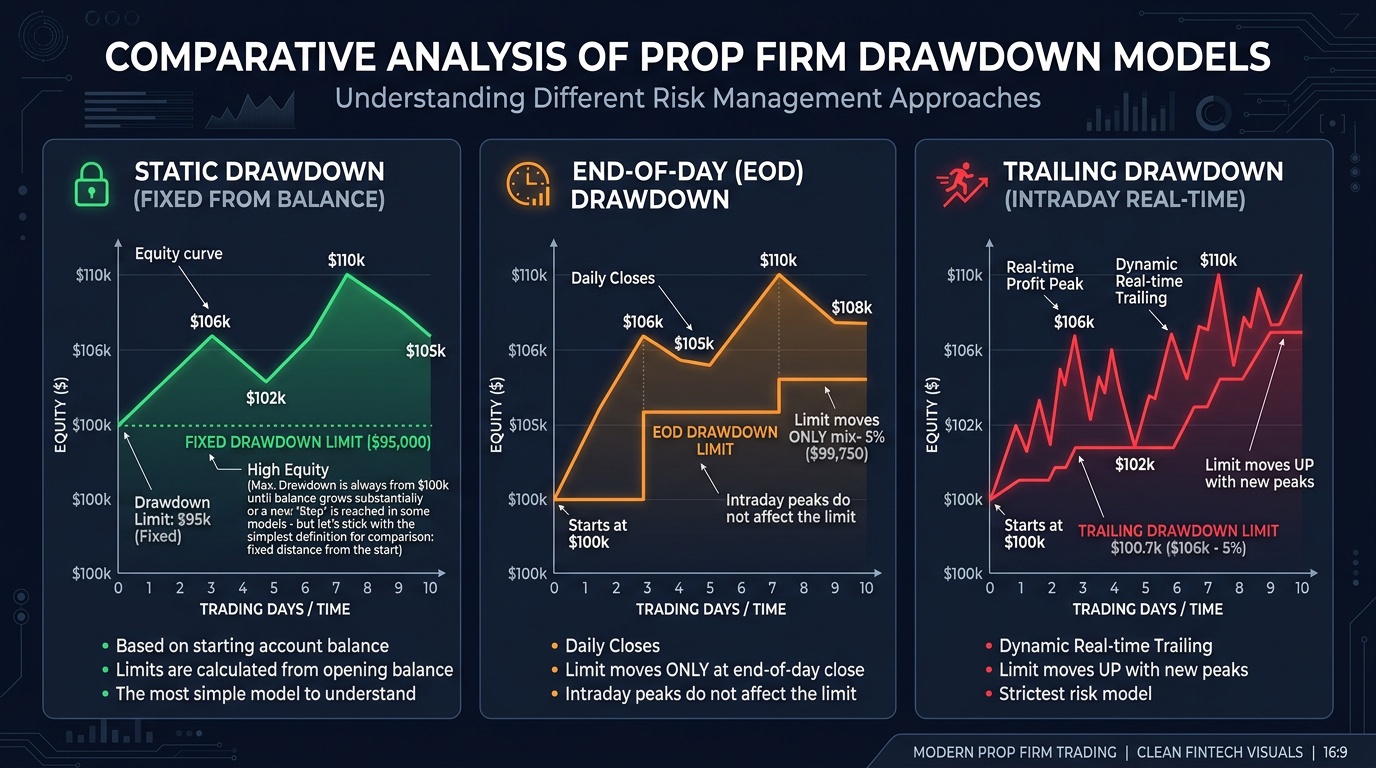
Drawdown rules are the single biggest reason funded traders lose accounts — often before they ever cash a payout.
Understanding how each type behaves under live P&L swings is non-negotiable when picking a firm in 2026. There are three dominant structures you'll encounter: daily drawdown, trailing (or end-of-day trailing) drawdown, and static (or absolute) drawdown. Each one creates a very different risk envelope, and the same trading style can pass at one firm and blow up at another purely because of how the loss limit is calculated. Here's a quick comparison of how the three behave in practice:
| Drawdown Type | How It's Calculated | Trader-Friendliness | Best For |
|---|---|---|---|
| Daily | Resets each day from balance or equity at session open | Medium | Day traders, scalpers |
| Trailing | Follows your highest balance/equity, then locks at initial deposit | Low to Medium | Disciplined swing traders |
| Static | Fixed dollar floor that never moves | High | Swing traders, long holds |
A static drawdown is generally the most forgiving — once you're up, your buffer only grows. Trailing drawdowns punish giving back profits, which is brutal for traders who scale into winners. Daily drawdowns, meanwhile, demand strict intraday risk control but offer a clean slate every session. If you want to dig deeper into matching drawdown style to capital level, see our guide on how to choose the right prop firm account size.
Leverage, Instruments & Platform Restrictions
Leverage in 2026 has tightened across the board, partly due to regulatory pressure and partly because firms learned that excessive leverage equals excessive blow-ups (and excessive refund obligations).
Most reputable firms now offer between 1:30 and 1:100 on FX majors, with crypto and indices typically capped lower at 1:5 to 1:20. Platform availability is another underrated filter. Not every firm supports every platform, and execution quality varies wildly between them. Here's what's typical across the industry today:
-
MetaTrader 4 (MT4): Still widely supported, especially for FX-only firms, but slowly being phased out.
-
MetaTrader 5 (MT5): The current default for most multi-asset prop firms; better for futures and equities exposure.
-
cTrader: Preferred by scalpers and algo traders for depth-of-market and faster execution.
-
DXtrade: Increasingly common at newer prop firms, browser-based, decent for casual traders but fewer third-party tools.
Instrument restrictions are where many traders get blindsided. Some firms ban news trading outright; others restrict crypto on weekends, prohibit holding over rollover, or disallow specific exotics. Always read the trading rules document — not just the marketing page — before funding. A firm offering "1:100 leverage on 500+ instruments" might exclude exactly the pairs or sessions you trade most.
Payout Structures: 80/20, 90/10, and Scaling Plans Payout splits have become a marketing battleground.
A few years ago, an 80/20 split (you keep 80%) was considered generous. In 2026, 90/10 is the new floor at competitive firms, with several offering 90% from day one and a handful pushing 95% after consistent performance. But the headline number is only part of the story. What actually determines your real take-home is the combination of split percentage, payout frequency, minimum payout threshold, and scaling plan mechanics. Here's how a typical structure stacks up:
| Payout Element | Standard Tier | Premium Tier |
|---|---|---|
| Profit Split | 80/20 | 90/10 (up to 95/5) |
| First Payout Window | 30 days | 7-14 days |
| Ongoing Frequency | Bi-weekly | Weekly or on-demand |
| Minimum Withdrawal | $100-$200 | $50 or none |
Scaling plans are where firms try to lock in long-term winners. The typical model:
- Hit a profit target (often 8-10%) over a defined period.
- Maintain a minimum number of trading days with no rule breaches.
- Receive an account size increase of 25-50%, sometimes with a better split.
- Repeat until you reach the firm's maximum allocation cap (commonly $1M-$4M).
In practice, scaling sounds great but rarely delivers as advertised. Many traders never qualify because the rules require both consistency and fresh profit on the scaled balance — meaning a single losing month can reset progress. Treat scaling as a bonus, not a core part of your income strategy.
A 90/10 split on a firm that pays late, refuses withdrawals on technicalities, or quietly resets your scaling tier is worth less than an honest 75/25 from a firm that always pays on time.
The takeaway: payout reliability beats payout percentage every single time. Cross-reference any firm's stated split with verified trader payout proofs from independent communities before you commit. For a broader framework that ties drawdown, leverage, and payout reliability into one decision matrix, our complete trader's guide to choosing a prop firm in 2026 walks through the full vetting process step by step.
Hidden Gotchas: Consistency Rules, IP Bans & EA Restrictions Beyond drawdowns, the most common reason traders get denied payouts in 2026 is buried in the fine print.
Consistency rules are the biggest offender — many firms now require that no single trading day account for more than 25–40% of your total profit.
Hit a home run on NFP day and you may be forced to grind out matching volume before you can withdraw anything. Then there are the operational traps. IP and device restrictions are increasingly strict: logging in from a VPN, a coworking WiFi, or a second country during travel can trigger a manual review. Firms also cross-check IP addresses between accounts — if you and a friend trade from the same household, both accounts can be flagged for "collusion" and voided. EA and copy-trading bans deserve their own warning. Even firms that advertise "EAs allowed" often prohibit commercial EAs, HFT bots, latency arbitrage, tick scalping, and any strategy that mirrors signals across accounts. If your edge depends on automation, read the Terms of Service line by line before funding an evaluation. Watch for these specific clauses before you buy a challenge:
- Minimum trading days that reset after a single rule breach
- Consistency ratios applied to both the evaluation AND the funded stage
- News-trading windows (often 2–5 minutes around red-folder events)
- Maximum lot size caps that scale with account balance
- Hedging restrictions across correlated pairs or across accounts
- Profit-split clawbacks if "prohibited strategies" are detected retroactively
Top Prop Firms vs the Competition: Quick Comparison Table No single firm wins on every dimension — the right pick depends on your style, capital, and risk tolerance.
Below is a simplified snapshot of how the major categories of firms stack up in 2026. Use it as a starting point, then verify current rules directly on each firm's site since terms change frequently.
| Firm Type | Pros | Cons | Best For |
|---|---|---|---|
| Established Futures Firms | Proven payout history, static EOD drawdown, real exchange data | Higher monthly fees, stricter consistency rules | Day traders who want reliability |
| Large FX/CFD Firms | Fast payouts, generous scaling, frequent discounts | Trailing drawdowns, EA restrictions, swap fees | Swing and intraday FX traders |
| Instant Funding Firms | No evaluation, immediate capital, simple rules | Lower profit splits, tighter drawdowns, higher cost | Experienced traders with proven edge |
| Newer Crypto-Native Firms | On-chain payouts, 24/7 markets, innovative products | Shorter track record, regulatory uncertainty | Crypto-focused systematic traders |
A few practical notes when using this table. First, "payout reliability" is only meaningful with at least 12 months of public payout proof — anything younger is still in the trust-building phase. Second, cheap challenges are rarely a bargain if the consistency rule is 20% or stricter. Third, a 90% profit split sounds amazing until you discover the 10% platform fee, the 2% data fee, and the $50 payout processing charge. For a firm-by-firm breakdown with current pricing, see our How to Choose a Trustworthy Prop Firm in 2026: The Complete Trader's Guide and the related rules deep-dive in How to Choose a Trusted Prop Firm in 2026: Rules, Drawdown & Payouts Explained.
Final Verdict: Building Your Prop Firm Shortlist
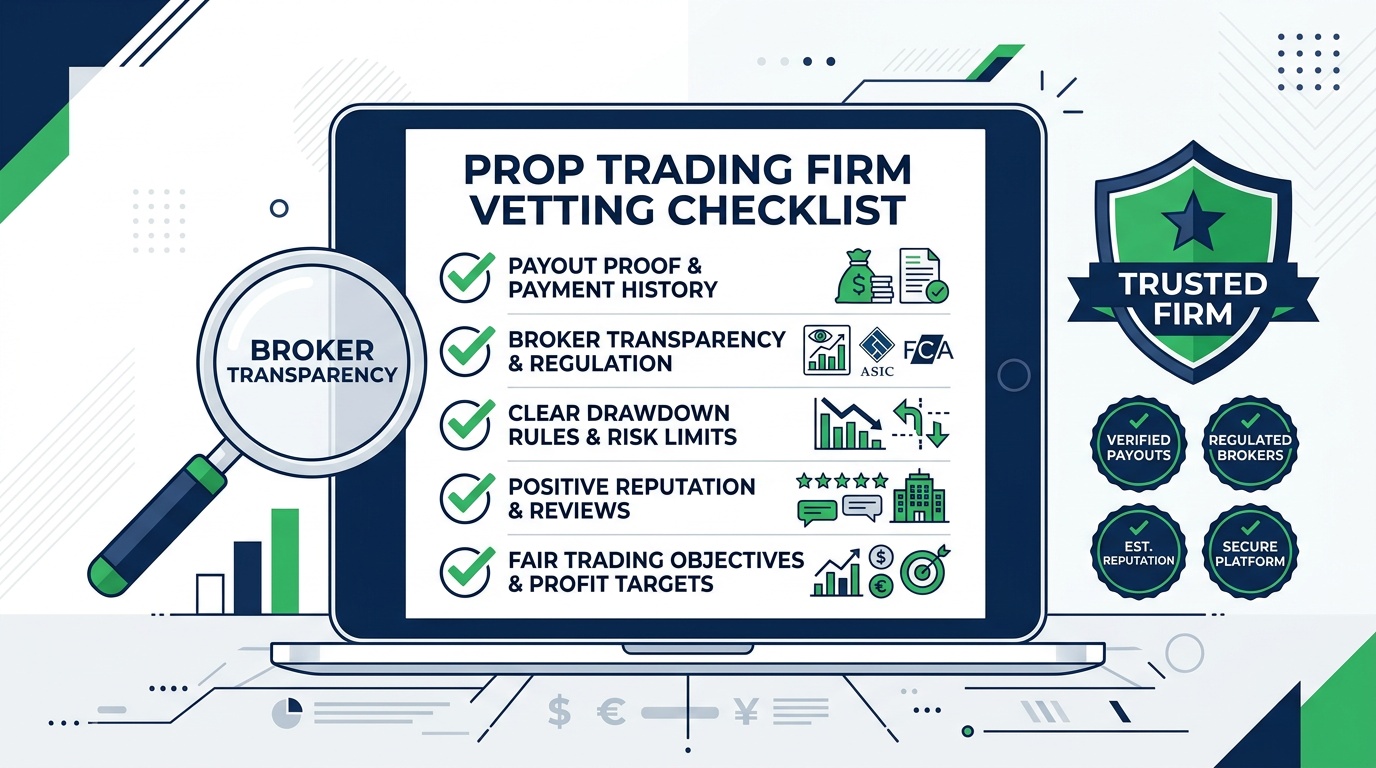
The marketing is noisy, but the filter is simple. Run every firm you're considering through this final checklist:
- Is the parent company, jurisdiction, and ownership publicly identifiable?
- Is the drawdown type (daily, trailing, static) clearly stated and compatible with your style?
- Are there at least 12 months of third-party verified payout proofs?
- Do the consistency, news, and EA rules let your actual strategy breathe?
- Are total costs (challenge fee, data, platform, payout) transparent before you buy?
- Does support respond within 24 hours with substantive answers, not templates?
If a firm fails even two of these checks, move on — there are dozens of legitimate alternatives competing for your business right now. Also match the account size to your realistic risk: our guide on how to choose the right prop firm account size walks through the math.
The best prop firm isn't the one with the biggest discount — it's the one that will still be paying you in 24 months.
Ready to act? Head to our regularly updated Best Prop Firms 2026 rankings and the active coupon page on askpropfirm.com to lock in current discounts on firms that have already passed this vetting framework. Build your shortlist, start with one evaluation, and let your results — not the marketing — decide where your capital goes next.