How to Choose a Trustworthy Prop Firm in 2026: The Complete Trader's Guide
AskPropFirm Team
Prop Mindset & Discipline Expert
Learn how to evaluate prop firms in 2026 by drawdown rules, payout reliability, leverage, and hidden gotchas. Expert checklist for serious traders.
The prop trading industry in 2026 looks nothing like it did just two years ago. Over 80 firms have collapsed since 2024, taking trader payouts, challenge fees, and reputations down with them. For serious traders, choosing a prop firm is no longer about who offers the biggest discount code or the flashiest Discord server — it's about survival. The wrong choice can mean weeks of disciplined trading evaporating overnight when a firm freezes withdrawals or quietly changes its terms. This guide is built for traders who want to evaluate prop firms the way an institutional risk officer would: methodically, skeptically, and with a clear understanding of what the rules actually mean in practice. We'll start with the foundation — trust — and then move into the single most misunderstood mechanic in the industry: drawdown.

Why Trust Is the #1 Factor in Prop Firm Selection
Every prop firm in 2026 will promise you the same things: high profit splits, fast payouts, scaling plans, and "trader-friendly" rules. The marketing is nearly identical across the industry because it works — new traders chase the headline numbers and ignore the fine print. But the firms that actually pay traders consistently are not always the ones with the loudest advertising. In many cases, they're the quieter operators with multi-year track records, transparent ownership, and verifiable payout proof.
Trust matters more than any single rule because every other feature of a prop firm is contingent on the firm honoring its agreement. A 90% profit split is worthless if withdrawals are delayed for six months. An 8-figure scaling plan means nothing if the firm rewrites its terms the week before your first payout. As we covered in The Great Prop Firm Shakeout, the firms that disappeared in 2024 and 2025 almost all shared the same warning signs months before they collapsed.
Here are the trust signals that should weigh more than marketing claims:
- Verifiable payout history — public proof, third-party tracker listings, and consistent payout cadence over 12+ months.
- Transparent ownership — named founders, registered legal entity, real office or jurisdiction.
- Stable rule history — no surprise rule changes, no retroactive enforcement, no sudden "consistency" requirements appearing after a trader passes.
- Liquidity provider transparency — the firm names its broker, technology provider, or LP relationships.
- Reasonable promises — if the offer sounds too generous (98% splits, instant funding, no rules), it usually masks a fragile business model.
A trustworthy prop firm makes its money when you make money. A predatory one makes its money when you fail. The business model tells you everything about how the firm will treat you.
The discount code culture has made this harder. Affiliates push whichever firm pays the highest commission this week, not whichever firm is most likely to pay you in three months. Before you trust any review, check whether the reviewer has skin in the game beyond a referral link — and whether the firm itself has skin in the game beyond your challenge fee.
Understanding Drawdown Rules: Daily vs. Maximum
If trust is the foundation, drawdown is the structure built on top of it. More traders fail prop firm challenges from misunderstanding drawdown mechanics than from poor strategy. The difference between a 5% daily / 10% maximum static drawdown and a trailing equity drawdown can completely change which strategies are viable on a given account. Let's break down the four common structures you'll encounter in 2026:
| Drawdown Type | How It's Calculated | Best For | Watch Out For |
|---|---|---|---|
| Daily (e.g., 5%) | Resets each trading day from start-of-day balance or equity | Day traders, scalpers | Whether it's balance-based or equity-based mid-trade |
| Static Maximum (e.g., 10%) | Fixed dollar threshold from initial balance, never moves | Swing traders, longer holds | Doesn't reward growth — once hit, account closes |
| Trailing Maximum | Follows your highest equity or balance up to a cap | Consistent grinders | Locks in profits as new floor — one bad day can blow it |
| End-of-Day Trailing | Trails based on closing balance, not intraday peaks | Intraday strategies | Open trades don't extend the buffer |
Daily drawdown typically resets each session, which sounds forgiving until you realize most firms calculate it on equity, not balance. That means a single open losing trade — even one you intend to hold through news — can breach the rule before you've technically "lost" anything. Always confirm whether daily drawdown is based on starting balance, starting equity, or floating equity.
Maximum drawdown is where most accounts actually die. A static maximum drawdown is the trader-friendly version: if you start with $100,000 and the max drawdown is 10%, your account closes only if equity touches $90,000 — regardless of whether you've grown the account to $120,000 first. A trailing maximum drawdown is far more restrictive: as your equity rises, the floor rises with it, often locking in profits and reducing your real risk buffer to a sliver of what the marketing implied.
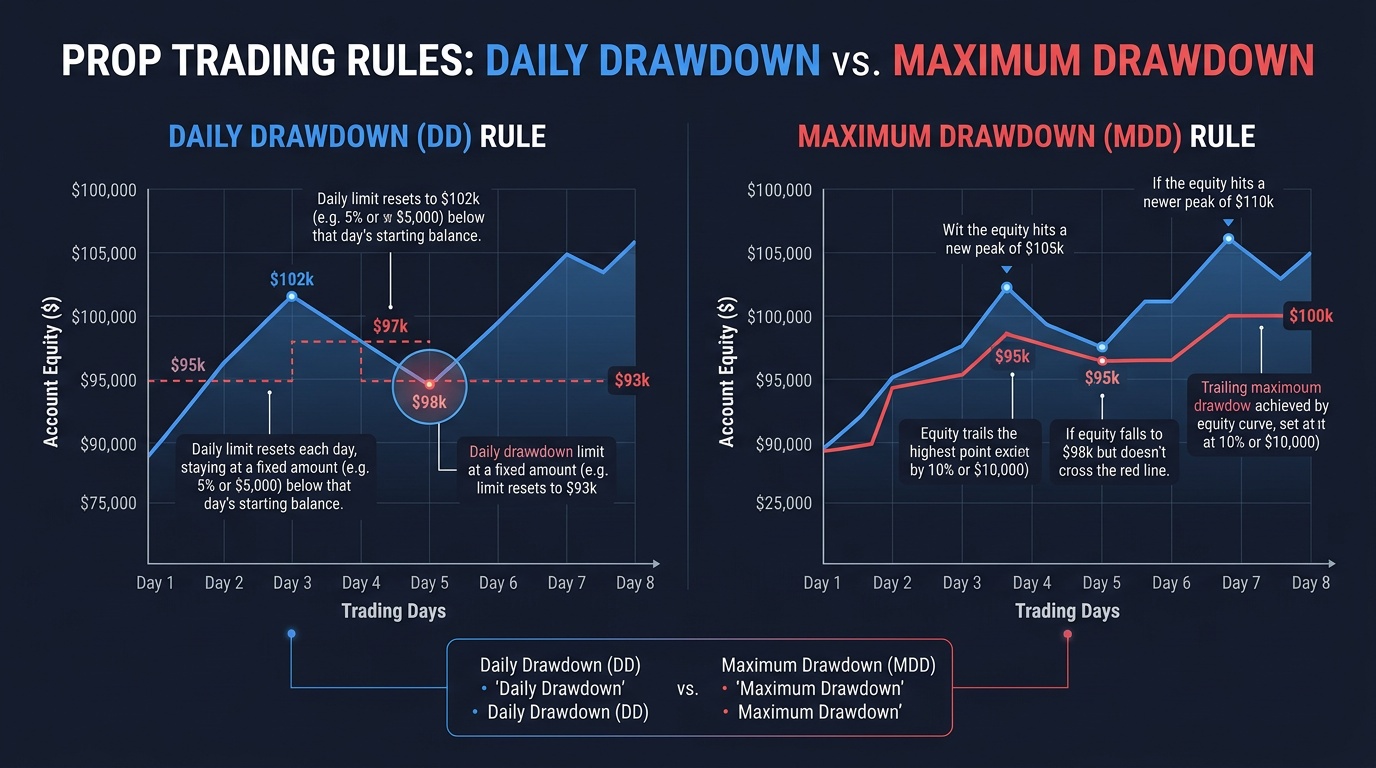
Consider a practical example. You pass a $100,000 challenge with a 6% trailing drawdown. You grow the account to $106,000 in your first week. Your drawdown floor has now trailed up to $100,000 — meaning you have effectively zero buffer left to give back any of those gains before the account closes. One normal pullback wipes you out. A trader using the same strategy on a static drawdown account would still have a $6,000 cushion below their original starting balance.
This is why account selection and strategy must match. A scalper who closes flat each day can thrive under tight trailing drawdown. A swing trader who needs room for trades to breathe will be forced into premature exits and eventually stopped out by the trail. Before you pay for any challenge, map your average trade duration, typical drawdown per position, and worst historical losing streak against the firm's specific rules. We cover the full strategy-fit framework in How to Pass a Prop Firm Challenge, but the principle is simple: the rule has to fit the trader, not the other way around.
Leverage and Asset Class Considerations
Leverage is one of the most misunderstood variables in prop trading. On paper, a 1:100 leverage ratio on Forex sounds aggressive — but in the context of a funded account with tight drawdown rules, it's often the bare minimum needed to execute a normal position-sized strategy. Indices typically come with 1:20 leverage, metals with 1:30, and crypto CFDs with 1:2 to 1:5. These ratios aren't arbitrary; they reflect each asset's volatility and the firm's risk appetite.
For scalpers, higher leverage on Forex majors (1:100 or more) enables the quick in-and-out trades that define the style. A scalper targeting 3–5 pip moves on EUR/USD needs enough notional exposure to make those small moves meaningful. Swing traders, by contrast, benefit less from raw leverage and more from overnight-holding permissions and weekend-holding rules — features many firms restrict or penalize.
Here's a quick comparison of typical leverage across major asset classes in 2026:
| Asset Class | Typical Prop Firm Leverage | Best Suited For |
|---|---|---|
| Forex Majors | 1:50 – 1:100 | Scalpers, day traders |
| Forex Minors/Exotics | 1:20 – 1:30 | Day traders |
| Indices (S&P, NAS) | 1:10 – 1:20 | Swing, day traders |
| Gold / Silver | 1:20 – 1:30 | Day, swing traders |
| Crypto CFDs | 1:2 – 1:5 | Swing traders |
| Oil / Commodities | 1:10 – 1:20 | Swing traders |
Before committing, match the firm's leverage to your actual trading style. If you trade indices primarily but the firm caps index leverage at 1:10, your strategy may no longer be viable. For a deeper look at how account size interacts with leverage, see our guide on How to Choose the Right Prop Firm Account Size.
Payout Structures and Withdrawal Reliability
Payout splits are the headline number most firms advertise, but the structure behind them matters far more than the percentage. An 80/20 split paid reliably every 14 days is worth significantly more than a 90/10 split with vague terms and frequent "review" delays. In 2026, the market has largely standardized around 80/20 as the baseline, with top-tier firms offering 90/10 after consistent performance or as a scaling reward.
Payout cycles typically fall into three categories:
- Bi-weekly payouts (every 14 days) — The industry standard and the most trader-friendly cycle.
- Monthly payouts (every 30 days) — Common among larger, more conservative firms.
- On-demand payouts — Offered by a handful of premium firms, typically after a minimum holding period and subject to minimum profit thresholds.
The real test is reliability, not frequency. Before funding an account, search trader forums, Trustpilot, and Discord communities for recent payout proof. Look for dated screenshots from the last 30–60 days — not testimonials from a year ago. A firm that was paying reliably in 2024 may be struggling today, as the great prop firm shakeout has demonstrated.
Red flags to watch for in payout structures include:
- Manual review clauses that let the firm delay payouts indefinitely for "verification"
- Profit caps per payout cycle that force you to withdraw in small increments
- Minimum holding periods exceeding 14 days before the first payout
- Payout denial clauses tied to vague "trading pattern" or "consistency" violations
- Crypto-only payouts with no fiat alternative, which can mask liquidity problems
If a firm's terms of service use phrases like "at the firm's sole discretion" around payouts, treat it as a warning sign. Legitimate firms define their payout criteria objectively and stick to them.
Hidden Gotchas: Consistency Rules, IP Restrictions, and EA Bans
This is where most traders get blindsided. The drawdown rules and profit targets are spelled out clearly on the landing page — but the clauses that actually disqualify accounts are usually buried deep in the terms of service. In 2026, three hidden rules do more damage than all other violations combined.
Consistency rules are the single most common reason funded accounts get disqualified after hitting profit targets. A typical consistency clause states that no single trading day may account for more than 30–40% of total profits. If you hit your target in one lucky session, the firm can refuse the payout — even though nothing in the challenge phase warned you against it. Some firms extend this to position sizing, requiring that your largest trade never exceed 2x your average risk per trade.
IP and geographic restrictions have tightened significantly since 2024. Many firms now ban VPN use outright, and some disqualify accounts flagged as trading from a country different than the registration country. If you travel, commute, or use a corporate network, check whether the firm's monitoring will flag it. A surprising number of traders lose accounts not from bad trades, but from logging in while on vacation.
EA and news trading bans are the third major gotcha. Expert Advisors, copy trading, high-frequency arbitrage, and trading during major news releases (often defined as ±2 to ±5 minutes around red-folder events) are commonly prohibited. Some firms even ban holding trades through news, meaning positions opened legitimately must be closed before the release.
Here's a checklist of rules to verify before you commit:
- Is there a consistency rule? If yes, what's the daily profit cap percentage?
- Are EAs, bots, or copy trading allowed on funded accounts?
- What's the news trading policy — and does it include crypto and indices news?
- Are VPNs, multiple IPs, or international logins permitted?
- Are there any "martingale," "grid," or "hedging" strategy bans?
- What happens if you violate a rule — warning, soft breach, or instant termination?
For a full breakdown of the rule categories worth auditing before funding an account, our Prop Firm Trust & Rules Guide 2026 walks through each gotcha with real examples. The firms worth trading with publish these rules openly; the ones to avoid hide them behind legal boilerplate and only enforce them after you've become profitable.
Trustpilot Scores and Community Reputation Checks
A 4.8-star Trustpilot rating looks reassuring until you start reading the reviews. Many prop firms inflate their scores through incentivized feedback — offering discount codes or free challenge retries in exchange for five-star reviews. Before you trust the headline number, filter Trustpilot by the one- and two-star reviews and look for patterns. Repeated complaints about denied payouts, moved goalposts, or unresponsive support matter far more than the aggregate score.
Reddit is the single best unfiltered source for prop firm intelligence. Subreddits like r/Daytrading, r/Forex, and r/propfirms regularly surface payout proof screenshots, rule-change controversies, and firm shutdowns in real time. Search the firm's name plus keywords like "payout denied," "account breached," or "scam" to find the threads moderators haven't buried. If a firm has quietly changed its consistency rules or restricted EA usage, Reddit will know weeks before the firm's blog admits it.
Discord communities add a third layer of verification. Most serious prop firms run official Discord servers where traders share withdrawal screenshots and ask support questions publicly. Join at least two or three of these before committing capital. Pay attention to how moderators respond to criticism — firms that delete negative questions or ban users for asking about payout delays are signaling exactly what you need to know.
A trustworthy firm welcomes scrutiny. If leadership hides from hard questions in their own community channels, assume the worst and walk away.
Finally, cross-reference findings with our [Prop Firm Trust & Rules Guide