How to Choose a Trusted Prop Firm in 2026: Rules, Drawdown & Payouts Explained
AskPropFirm Team
Prop Mindset & Discipline Expert
Learn how to evaluate prop trading firms in 2026. Compare drawdown rules, leverage, payout splits, and trust scores to find a reliable funded account provider.
The prop trading industry has changed more in the last 18 months than in the previous decade. Since 2024, more than 80 firms have collapsed, rebranded, or quietly stopped paying traders — and the survivors have rewritten their rulebooks at least twice. If you're shopping for a funded account in 2026, the old advice ("pick the highest profit split") is the fastest way to lose your evaluation fee. This guide walks you through the trust-first framework that experienced traders now use to evaluate prop firms: how to read drawdown rules properly, how to spot payout red flags, and how to compare offers without falling for marketing gloss. By the end of this part, you'll understand why a 70% split from a reliable firm beats a 95% split from one that ghosts you on payout day.

Why Trust Matters More Than Profit Splits in 2026 For years, prop firm marketing has trained traders to compare offers on a single axis: the profit split. 80%, 90%, even 100% on the first payout — the numbers got louder while the rules got quieter. In 2026, that priority is inverted. The traders who consistently withdraw money care less about whether their split is 80% or 90%, and more about whether the firm will still be processing payouts in six months. The reason is simple: a profit split only matters if the payout actually arrives. A 90% split on a $10,000 profit is worth exactly $0 if the firm delays your withdrawal for 60 days, suddenly invokes a "consistency rule" you didn't know existed, or quietly disappears from Discord. Meanwhile, a boring 75% split from a firm with a verifiable two-year payout history compounds into real income. The trust-first framework ranks firms on four pillars before price ever enters the conversation: 1. Payout history — Public, verifiable proof of withdrawals over at least 12 months, ideally with on-chain or bank-statement evidence.
- Rule stability — How often the firm has changed its drawdown, consistency, or news-trading rules in the last year.
- Liquidity backing — Whether profits are paid from real broker P&L, A-book flow, or simply from new challenge fees (a Ponzi structure that collapses fast).
- Communication — Response times on support tickets, transparency during outages, and whether the CEO is a real person or an AI-generated avatar. > A profit split is a promise. A payout history is evidence. Trade with firms that show evidence. If you want a deeper structured breakdown of each pillar, the Prop Firm Trust & Rules Guide 2026 walks through exactly which documents and data points to request from any firm before funding an evaluation.
Understanding Drawdown Rules: Daily vs. Max Loss Limits Drawdown rules are where most traders get eliminated — not because they're bad traders, but because they misread the fine print. Almost every prop firm in 2026 uses two stacked limits: a daily loss limit (typically 4–5% of account size) and a maximum loss limit (typically 8–10%). Hit either one, even by a single tick, and the account is gone. No appeals, no second chances. The trick is that these two limits behave very differently, and the maximum loss limit comes in two flavors — static and trailing — that produce wildly different outcomes from identical trades. Here's how the three mechanics compare on a $100,000 account with a 5% daily limit and 10% max drawdown:
| Rule Type | Starting Threshold | Behavior After +$5,000 Profit | What Triggers a Breach |
|---|
| Daily loss (5%) | $95,000 | Resets each day at 5pm ET to balance − 5% | Equity drops below daily floor intraday | | Static max drawdown (10%)
| $90,000 | Stays at $90,000 forever | Equity touches $90,000 | | Trailing max drawdown (10%)
| $90,000 | Trails up to $95,000 (locks at initial balance) | Equity touches the trailing floor | | Trailing (unlocked)
| $90,000 | Trails up indefinitely with new equity highs | Equity touches the moving floor | Take a real example. You're up $5,000 on a $100k account. You enter a new trade and the market moves $4,000 against you intraday before recovering. - Under a static 10% drawdown, your floor is still $90,000. You're sitting at $101,000 of equity — completely safe.
-
Under a locked trailing drawdown, your floor moved up to $95,000. You're at $101,000 — still safe, but with much less room.
-
Under an unlocked trailing drawdown, your floor trailed all the way to $100,000 (your previous high of $105,000 minus 5% buffer). That same $4,000 drawdown breaks your account. This is why two traders with identical strategies can have completely different outcomes at different firms. The rule type matters more than the headline drawdown percentage.
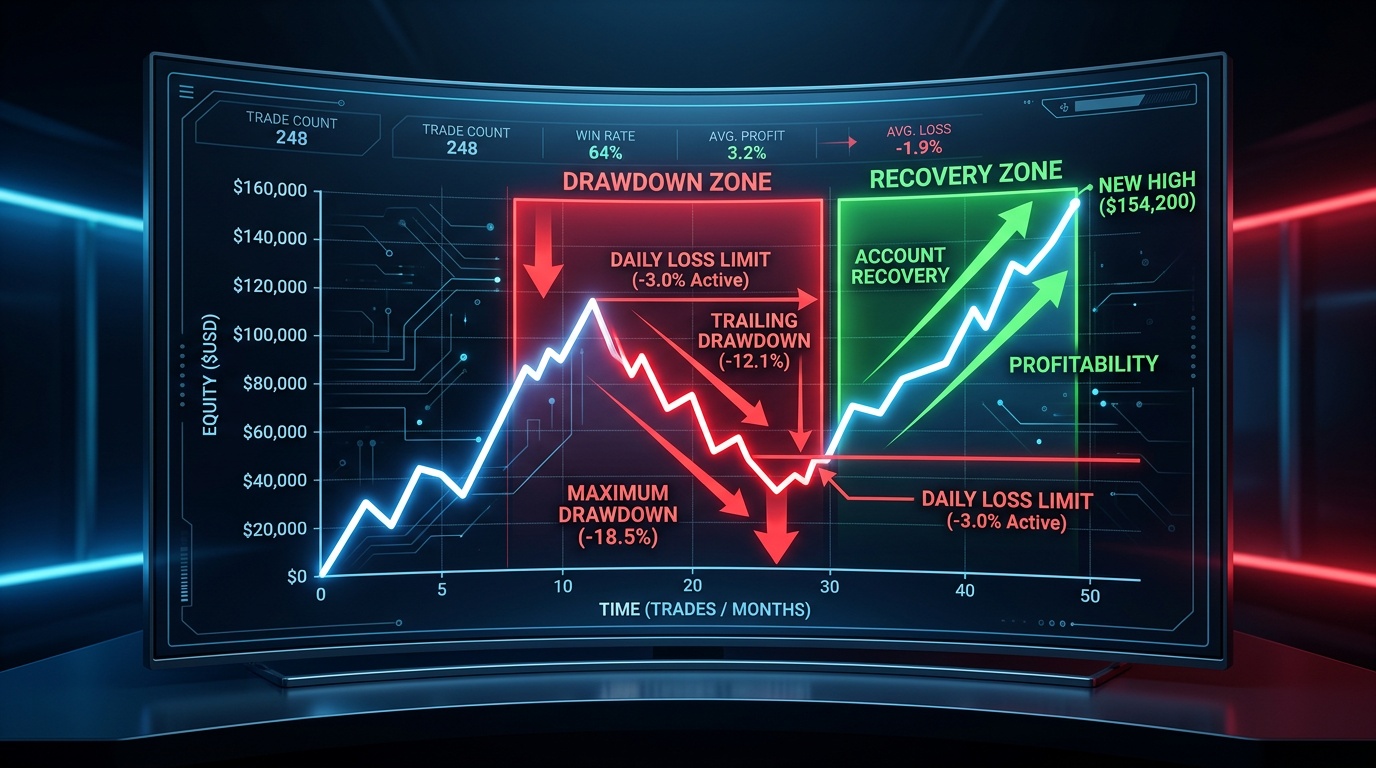 A few practical tips for surviving drawdown rules: - Treat the daily limit as 80% of the stated number. If the rule is 5%, manage to 4%. Slippage, swap fees, and weekend gaps eat the rest.
-
Know your reset time. Daily limits typically reset at 5pm New York time, not midnight. A trade held through the reset is judged against tomorrow's floor.
-
Never scale up after a green week if you're on a trailing account. That's exactly when traders blow up — the trailing floor is now tight against your new high. If you're still deciding which account size to start with, your drawdown tolerance should drive that choice more than your ego. The companion guide on how to choose the right prop firm account size walks through sizing your evaluation around realistic per-trade risk rather than dream payouts. In the next part of this guide, we'll move from drawdown mechanics to the payout side: split structures, withdrawal cycles, scaling plans, and the specific red flags that separate firms worth funding from firms about to join the 80-firm graveyard.
Leverage and Instrument Access Across Top Firms Leverage and instrument breadth often determine which prop firm fits your strategy more than headline pricing does. Most forex-focused firms in 2026 offer standard 1:100 leverage on majors, with some scaling down to 1:50 on exotics and 1:30 on metals during high-impact news. Futures-specialized firms operate under contract limits instead of leverage ratios — typically 5 micro contracts on a $50K evaluation, 10 on a $100K, and 15–20 on a $150K account. Crypto and index access has widened significantly over the last two years. Where 2023-era firms often restricted weekend BTC trading, most trusted providers now offer 24/7 crypto with 1:2 leverage, alongside US30, NAS100, SPX500, and DAX40 at 1:20 to 1:50. Commodity traders should verify whether gold and oil share the same drawdown pool as forex or trigger separate risk caps. Here's a rough comparison of what's typical among reputable firms in 2026:
| Instrument Class | Typical Leverage | Common Restrictions |
|---|
| Forex Majors | 1:100 | News window 2–5 min | | Forex Exotics
| 1:50 | Reduced weekend | | Indices
| 1:20 to 1:50 | No overnight on some firms | | Gold/Silver
| 1:30 | Lower during NFP | | Crypto
| 1:2 | Flat weekend margin | | Futures (micros)
| Contract-based | Scaling tiers | Before committing, match the instrument list to your actual trading style. A scalper running EUR/USD at 1:100 has very different needs than a swing trader holding NAS100 overnight. Our guide on How to Choose the Right Prop Firm Account Size pairs well with this decision.
Payout Splits and Withdrawal Frequency Explained Profit splits are the most advertised — and most misunderstood — number in prop trading. A headline "90/10 split" sounds superior to 80/20, but the real economics depend on payout frequency, minimum thresholds, and whether the split scales over time. Many firms start new funded traders at 80/20 and escalate to 90/10 after two or three successful payouts, while a few premium firms offer 90/10 from day one as a marketing differentiator. Withdrawal frequency matters as much as the split itself. The current landscape breaks down roughly like this: 1. Bi-weekly payouts (14 days) — the 2026 standard for established firms, often with a 5-trading-day minimum activity rule.
- Weekly payouts (7 days) — offered by a smaller group of firms, usually with stricter consistency requirements.
- On-demand payouts — marketed aggressively but frequently capped at one request per 14 days in the fine print.
- Monthly payouts — increasingly rare in 2026 and a yellow flag for trust scoring. Scaling plans add another layer. Most firms increase your account size by 20–25% every time you hit a 10% profit milestone and complete two consecutive payouts, capping between $400K and $2M of allocated capital. A 90/10 split on a scaled $500K account obviously dwarfs a 95/5 split on a static $50K, so do the math on lifetime earnings potential rather than fixating on the percentage alone. For a deeper walkthrough of challenge-to-payout pipelines, see How to Pass a Prop Firm Challenge: The Complete Guide.
Hidden Gotchas: Consistency Rules, IP Bans & EA Restrictions This is where funded accounts die — not in the evaluation, but after the first profitable month. Consistency rules are the most common invalidator. A typical clause states that no single trading day can exceed 30%–40% of your total profit for the payout period. One lucky gold trade on a Tuesday can retroactively disqualify a disciplined Wednesday–Friday, forcing you to keep trading just to dilute the concentration. IP and geography restrictions caught thousands of traders off-guard during the 2024–2025 shakeout. Many firms now block shared IP addresses (meaning two traders in the same household can trigger a "copy trading" violation), VPN connections, and residents of specific jurisdictions — even when the trader signed up legitimately. Always screenshot your KYC approval and home IP at funding day; this is the single most common evidence request when disputing an account termination. EA and automation restrictions have tightened sharply. Watch for these fine-print traps: - HFT bans — algos holding positions under 60 seconds are frequently disallowed.
-
Copy-trading prohibitions — running the same EA across multiple funded accounts can void all of them simultaneously.
-
News-trading windows — entering positions within 2–5 minutes of red-folder events often invalidates trades post-hoc.
-
Martingale/grid bans — most firms now scan for stacking behavior automatically.
-
Latency arbitrage clauses — broad language that can be used to deny payouts based on execution speed. The pattern across 80+ firm closures since 2024 is brutally consistent: traders pass the challenge, trade profitably for a month or two, request their first large withdrawal, and only then discover a clause that voids the account. Our breakdown in The Great Prop Firm Shakeout shows how these clauses were weaponized selectively against the firm's biggest winners. > Rule of thumb: if a firm's Terms of Service PDF is shorter than 10 pages, they either haven't thought through their risk model — or they're relying on ambiguity to deny payouts later. Before you wire your evaluation fee, read the full ToS twice, search the document for the words "sole discretion," "consistency," "similar strategy," and "abuse," and confirm each flagged clause against the firm's public payout proofs. The Prop Firm Trust & Rules Guide 2026 has a printable checklist you can run through in under fifteen minutes.
How to Verify a Prop Firm's Trust Score Before wiring any money to a prop firm, spend 20 minutes running independent checks. Trustpilot is the obvious starting point, but read the 1-star and 5-star reviews side by side — firms with 4.8+ ratings built entirely on "passed my challenge" reviews (rather than payout confirmations) are often gaming the system. Look for reviews that mention withdrawn funds, screenshot proofs, and dated payout cycles. Regulatory checks matter less for prop firms than for brokers, since most operate as educational or simulated-capital providers rather than licensed financial institutions. Still, verify the corporate entity: check Companies House (UK), the Dubai DED registry, or the relevant jurisdiction's business register. A firm unwilling to disclose its legal entity is a hard pass. Payout proof communities are your best real-world signal. Reddit's r/Daytrading and r/PropFirms, the PropFirmMatch Discord, and Telegram groups like "Prop Firm Payouts" post weekly proof threads where traders share transaction IDs and timestamps. Consistent weekly payouts from verified users across 6+ months is the strongest trust signal available in 2026. > Rule of thumb: if you can't find at least 10 independent payout proofs from the last 90 days, assume the firm is either too new or too risky to trust with evaluation fees. For a deeper framework on verifying firm longevity, see our guide on how 80+ firms collapsed since 2024 and how to verify yours will survive.
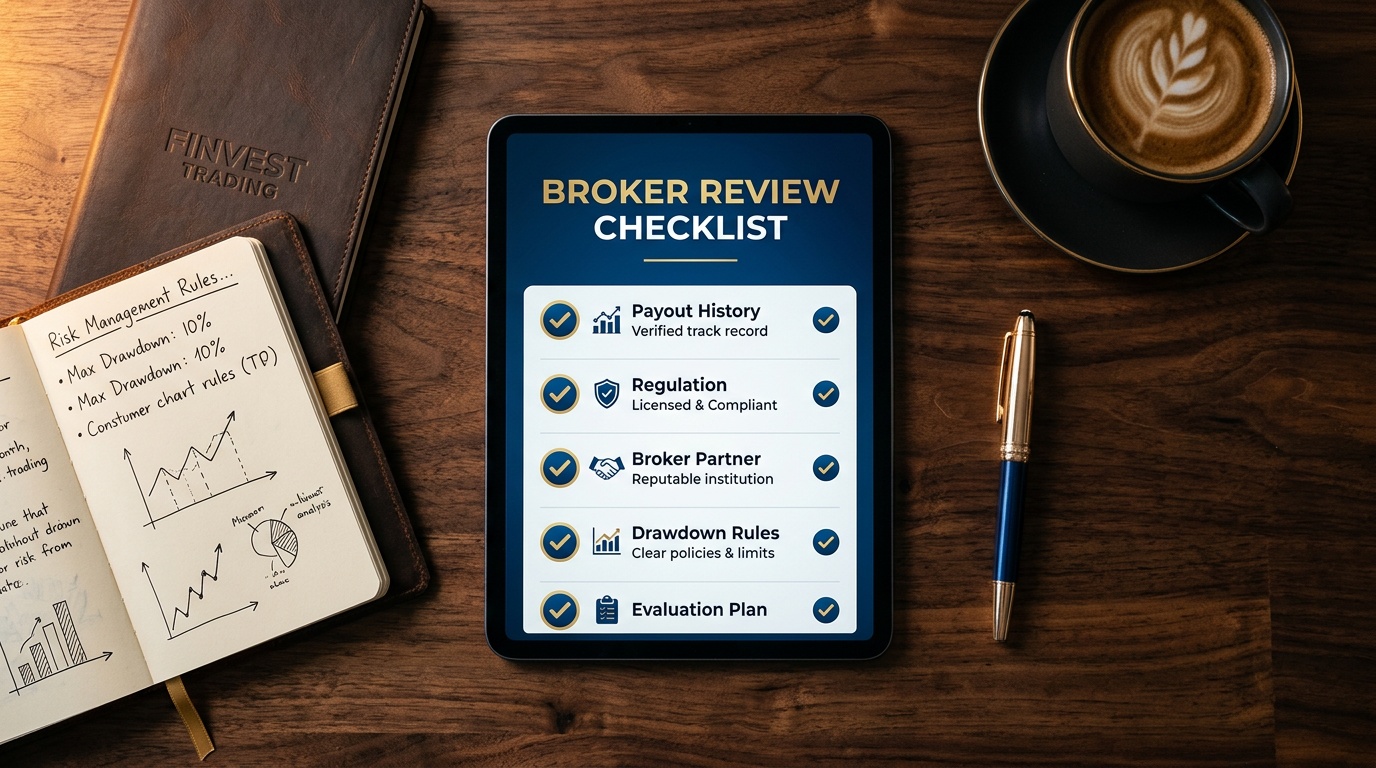
Pros & Cons Summary Table: What to Look For After reviewing dozens of firms for this guide, the pattern is clear: trustworthy providers share a handful of structural traits, and risky ones share a different set. Use the table below as a final checklist before funding any evaluation.
| Green Flags ✅ | Red Flags 🚩 |
|---|
| Static end-of-day drawdown clearly defined | Trailing drawdown with vague "high-water mark" language | | Public payout proofs weekly on Discord/Reddit
| Only curated testimonials on firm's own site | | Named founders with LinkedIn presence
| Anonymous ownership or stock-photo team pages | | Payouts processed within 1–3 business days
| "Review period" of 7–14 days before each payout | | Clear news-trading and weekend-hold policies
| Rules buried in PDFs or changed retroactively | | 70–90% profit splits with scaling plans
| 50% splits dressed up as "starter programs" | | 18+ months of continuous operation
| Launched within the last 6 months with aggressive discounts | | Broker/liquidity partner disclosed
| No mention of execution venue anywhere | If a firm scores 6+ green flags and zero red flags, it's a candidate. Anything with two or more red flags — especially around drawdown mechanics or payout delays — should be skipped regardless of how attractive the pricing looks.
Our #1 Recommended Prop Firm for 2026 Based on the trust framework above — verified payouts, static drawdown, transparent rules, and operational history predating the 2024 shakeout — our top-rated firm for 2026 combines an 90% profit split, 1:100 leverage on forex, static EOD drawdown, and same-day payout processing after the first withdrawal. It's one of the few providers offering both evaluation and instant-funding tracks without the trailing drawdown traps that sank weaker competitors. Rather than lock readers into a single recommendation, we maintain an updated shortlist because the landscape shifts quarterly. Here's how to move forward: 1. Review the full 2026 rankings in our best prop firms 2026 guide for side-by-side comparisons.
- Match the firm to your account size using our account-size selection guide.
- Prepare for the evaluation with our complete challenge-passing playbook.
- Double-check drawdown and payout specifics against our trust & rules breakdown.